

Vishnu
विष्णुThe preserver and protector of the universe. Also called Narayana, Hari, Keshava, Madhava, Govinda, Achyuta, Janardana, Padmanabha.
Vishnu is the preserver of the universe and, with Brahma and Shiva, one of the Trimurti. He rests on the serpent Shesha with Lakshmi beside him, rides Garuda, and descends as avatars such as Rama and Krishna whenever dharma declines. Vaishnavas worship him as the Supreme Being.
Who is Vishnu?
Vishnu (Sanskrit: विष्णु, Viṣṇu) is one of the principal gods of Hinduism. In the widely known framework of the Trimurti he is the preserver, who sustains the universe between its creation by Brahma and its dissolution by Shiva. Whenever dharma, the order that holds life together, declines, he descends into the world as an avatar to set it right. Rama and Krishna, the heroes of the two great epics, are his most beloved avatars.
For the Vaishnava traditions, one of the largest families of Hindu devotion, Vishnu is not one god among many but the Supreme Being himself, known as Narayana, Hari and Bhagavan. He rests on the serpent Shesha in the ocean of milk, rides the eagle Garuda, and is never apart from his consort Lakshmi, the goddess of fortune and grace.
What does the name Vishnu mean?
The name is usually explained as “the all-pervading one”. The grammarian Yaska, in his Nirukta (around the 4th century BCE), derives it from a root meaning to enter or pervade, and the commentator Medhatithi glosses Vishnu as the one who is everything and is inside everything. Vishnu is praised under a thousand names in the Vishnu Sahasranama, a hymn found in the Anushasana Parva of the Mahabharata. Among the most loved are:
- Narayana — the refuge of all beings, or the one who rests on the waters.
- Hari — the one who takes away sorrow and sin.
- Keshava — the one with beautiful hair, or the slayer of the demon Keshi.
- Madhava — the consort of Ma, Lakshmi.
- Govinda — the protector of cows, the earth and the senses.
- Achyuta — the one who never falls or fails.
- Janardana — the one whom people pray to for welfare.
- Padmanabha — the one from whose navel the lotus of creation grows.
- Vasudeva — the one who dwells in all beings; also Krishna’s name as son of Vasudeva.
Vishnu in the Vedas
Vishnu is an old god. In the Rigveda he is a solar deity with only five of the 1,028 hymns addressed to him, but those hymns contain the image that defines him ever after: his three great strides. Hymn 1.154 praises Vishnu who measured out the earthly regions with three steps, the first two visible to mortals and the third, his highest step, beyond the flight of birds. Verse 1.154.5 speaks of a spring of honey in that highest place, the paramam padam, which later tradition calls Vaikuntha.
In the Rigveda Vishnu is also the friend of Indra, helping him against the serpent Vritra, and hymn 7.99 says he propped apart heaven and earth. The Shatapatha Brahmana tells of Purusha Narayana, who contains all the worlds within himself, and the Narayana Sukta of the Taittiriya Aranyaka praises Narayana as the supreme reality. The three strides became the story of the Vamana avatar, and the Vedic boar that lifts the earth became Varaha.
Vishnu in the Trimurti
Many Hindus know Vishnu as one of three gods who share the work of the cosmos: Brahma creates, Vishnu preserves, and Shiva dissolves. The Maitri Upanishad links the three with the three gunas, the qualities of nature: Brahma with rajas (activity), Vishnu with sattva (goodness and balance) and Shiva with tamas (inertia and dissolution).
The Trimurti is a helpful starting point, but not every tradition sees it the same way. For Vaishnavas, Vishnu is the source of Brahma and Shiva; for Shaivas, Shiva is supreme; for Shaktas, the Goddess is. In the Smarta tradition associated with Adi Shankaracharya, Vishnu is one of five equal deities worshipped together in the panchayatana puja. A few modern movements, such as the followers of Rampal, go further and teach that Vishnu is a powerful but finite deity; that is their own interpretation and not the view of the mainstream traditions.
How do the Puranas describe creation?
The Vishnu Purana and the Bhagavata Purana tell the story of the cosmos in great cycles. At the end of a cycle the worlds dissolve into a single ocean, and Vishnu, as Narayana, sleeps upon the coils of Shesha in yoga-nidra, the sleep that is also deep meditation. When a new cycle begins, a lotus grows from his navel, and on it Brahma appears and begins to create the worlds. While Brahma is still bewildered, two demons born from Vishnu’s ears, Madhu and Kaitabha, try to steal the Vedas, and Vishnu awakens to slay them, which is why he is called Madhusudana.
The Bhagavata Purana uses a memorable image for this: Vishnu creates the universe from himself as a spider spins its web, sustains it, and draws it back into himself. The Gaudiya tradition of Bengal adds that countless universes rise and fall with the breathing of Maha-Vishnu, who lies in the causal ocean.
What does Vishnu look like?
Vishnu is usually shown as a young, serene king with dark blue or blue-black skin, the colour of the sky and the deep ocean. He wears a tall jewelled crown (kirita), earrings shaped like sea creatures (makara kundalas), a yellow silk garment (pitambara) and a long garland of forest flowers called Vaijayanti. On his chest are the jewel Kaustubha and the curl-shaped mark Srivatsa, the seat of Lakshmi.
In his four hands he holds four emblems: the discus Sudarshana Chakra, the conch Panchajanya, the mace Kaumodaki and the lotus Padma. Less often he carries the bow Sharanga and the sword Nandaka. Because the four emblems can be held in different hands, the Agni and Padma Puranas name twenty-four forms of Vishnu, such as Keshava, Narayana, Madhava, Govinda and Trivikrama, each defined by the order of the objects.
Temple images show Vishnu in three postures: standing (sthanaka), as at Tirumala; seated (asana), often with Lakshmi and Bhudevi; and reclining on Shesha (shayana), as at Srirangam and Thiruvananthapuram. He is also worshipped without any image at all, in the black ammonite stone called the shaligram, found in the Gandaki river of Nepal, and in the tulsi plant.
Who is Vishnu’s family?
Vishnu’s consort is Lakshmi, also called Sri, who rose from the ocean of milk during the Samudra Manthan and chose him as her husband. She accompanies him in every avatar: as Sita with Rama, as Rukmini (and, in many traditions, Radha) with Krishna, and as Padmavati with Venkateswara at Tirupati. In South Indian worship Vishnu is often shown with two consorts, Sridevi (Lakshmi) and Bhudevi (the Earth), and some traditions add a third, Niladevi.
In Vaishnava accounts, Brahma is born from Vishnu’s navel lotus, which makes Vishnu the father of the creator. As Krishna his sons include Pradyumna, and as the enchantress Mohini, the female form he took during the churning of the ocean, he is held in South Indian tradition to be a parent, with Shiva, of the god Ayyappa (Shasta).
Vishnu’s eternal companions include Garuda, his eagle mount; Shesha (Adishesha or Ananta), the serpent who is his couch and who descends with him as Lakshmana and Balarama; Vishvaksena, the commander of his host; and Jaya and Vijaya, the gatekeepers of Vaikuntha. The sage Narada, who wanders the worlds singing “Narayana, Narayana”, is his best-known devotee.
The five forms of Vishnu in the Pancharatra
The Pancharatra, one of the two great ritual traditions of Vishnu worship, teaches that the Lord exists in five ways at once:
- Para — the supreme, transcendent form in Vaikuntha.
- Vyuha — four emanations that govern the cosmos: Vasudeva, Sankarshana, Pradyumna and Aniruddha.
- Vibhava — the avatars, his descents into the world.
- Antaryami — the inner controller who lives in the heart of every being.
- Archa — the consecrated image in a temple or home, in which he makes himself available to be seen and served.
The other ritual tradition, the Vaikhanasa Agama, governs worship at many temples including Tirumala.
Sacred texts of Vishnu
- Bhagavata Purana — the most loved Vaishnava Purana, with the life of Krishna in Book 10 and the stories of many avatars.
- Vishnu Purana — one of the oldest Puranas, central to Vaishnava cosmology, genealogy and theology.
- Bhagavad Gita — Krishna’s teaching to Arjuna, including the promise of the avatar in 4.7 to 4.8.
- Vishnu Sahasranama — the thousand names, taught by Bhishma to Yudhishthira in the Mahabharata.
- Ramayana and Mahabharata — the epics of Rama and Krishna.
- Narayana Upanishad and the Vaishnava Upanishads — fourteen are counted in the Muktika canon.
- Nalayira Divya Prabandham — 4,000 Tamil hymns of the twelve Alvar saints, sung in temples to this day.
Vaishnava traditions
Devotion to Vishnu is carried by several living schools, or sampradayas, each with its own philosophy:
- Sri Vaishnavism, taught by Ramanujacharya (11th to 12th century): Vishishtadvaita, qualified non-dualism, in which Vishnu and Sri are inseparable and the soul is part of the Lord’s body.
- Madhva Sampradaya, founded by Madhvacharya (13th century): Dvaita, the eternal distinction between God and souls.
- Nimbarka Sampradaya: Dvaitadvaita, difference and non-difference, centred on Radha and Krishna.
- Pushtimarg, founded by Vallabhacharya (15th to 16th century): Shuddhadvaita and the worship of child Krishna as Shrinathji.
- Gaudiya Vaishnavism, from Chaitanya Mahaprabhu (16th century): ecstatic devotion and chanting of the Hare Krishna mantra.
- Ramanandi Sampradaya: devotion to Rama, the largest order of Vaishnava ascetics in North India.
- Regional movements such as the Warkari pilgrims of Pandharpur (Vitthala) and the Ekasarana Dharma of Srimanta Sankardev in Assam.
How is Vishnu worshipped?
- Mantras — the eight-syllable Om Namo Narayanaya and the twelve-syllable Om Namo Bhagavate Vasudevaya are the most widely recited.
- Aarti — Om Jai Jagdish Hare closes pooja in homes and temples across North India.
- Thursday (Guruvar) is Vishnu’s day, when devotees wear yellow and offer yellow sweets, bananas and chana dal.
- Ekadashi — the eleventh day of each lunar fortnight is kept as a fast for Vishnu; there are 24 in a year, the most important being Devshayani, Prabodhini and Vaikuntha Ekadashi.
- Tulsi and shaligram — tulsi leaves are indispensable in Vishnu worship, and the shaligram stone is worshipped as Vishnu himself.
- Satyanarayan Katha — a household vow on the full moon, telling stories of Vishnu as Satyanarayana, the Lord of truth.
- Chaturmas — the four months of the monsoon, from Devshayani Ekadashi to Prabodhini Ekadashi, when Vishnu is believed to sleep and devotees take extra vows.
Where is Vishnu worshipped?
Vishnu and his forms are worshipped in some of the largest temples on earth. The Sri Vaishnava tradition counts 108 Divya Desams, sacred abodes praised by the Alvars, 106 of them on earth. Among the best known are:
- Badrinath, Uttarakhand — one of the four Char Dham, where Vishnu meditates as Badrinarayana.
- Jagannath Temple, Puri — home of Jagannath and the great Rath Yatra.
- Tirumala Venkateswara, Andhra Pradesh — among the most visited shrines in the world.
- Sri Ranganathaswamy, Srirangam — the first of the Divya Desams and one of the largest functioning temple complexes.
- Padmanabhaswamy, Thiruvananthapuram — Vishnu reclining on Shesha.
- Guruvayur, Kerala — Krishna as Guruvayurappan.
- Dwarka, Gujarat — the city of Krishna.
- Angkor Wat, Cambodia — built in the 12th century by King Suryavarman II and dedicated to Vishnu.
- Prambanan, Java — whose 9th-century complex includes a temple to Vishnu beside those of Brahma and Shiva.
Vishnu beyond Hinduism
Sri Lankan Buddhists honour Vishnu, as Upulvan, as a guardian of the island and of the Buddha’s teaching. The Dasam Granth of the Sikh tradition retells the avatars in the Chaubis Avtar. In Jain tradition the heroes Krishna and Lakshmana belong to the nine Vasudevas, mighty half-world rulers of each cosmic age.
यदा यदा हि धर्मस्य ग्लानिर्भवति भारत।
अभ्युत्थानमधर्मस्य तदात्मानं सृजाम्यहम्॥
Whenever dharma declines and adharma rises, O Bharata, I bring myself forth.
The 10 avatars
Weapons and symbols


Aartis and mantras of Vishnu
Connected to Vishnu
 ConsortLakshmiलक्ष्मी
 MountGarudaगरुड़
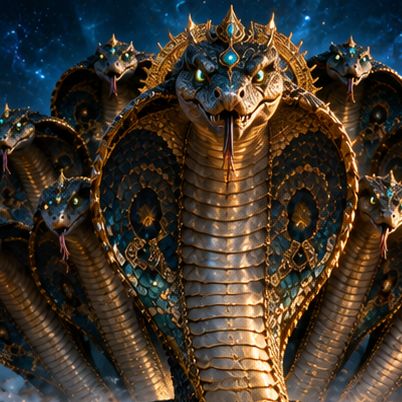 SerpentSheshaशेष
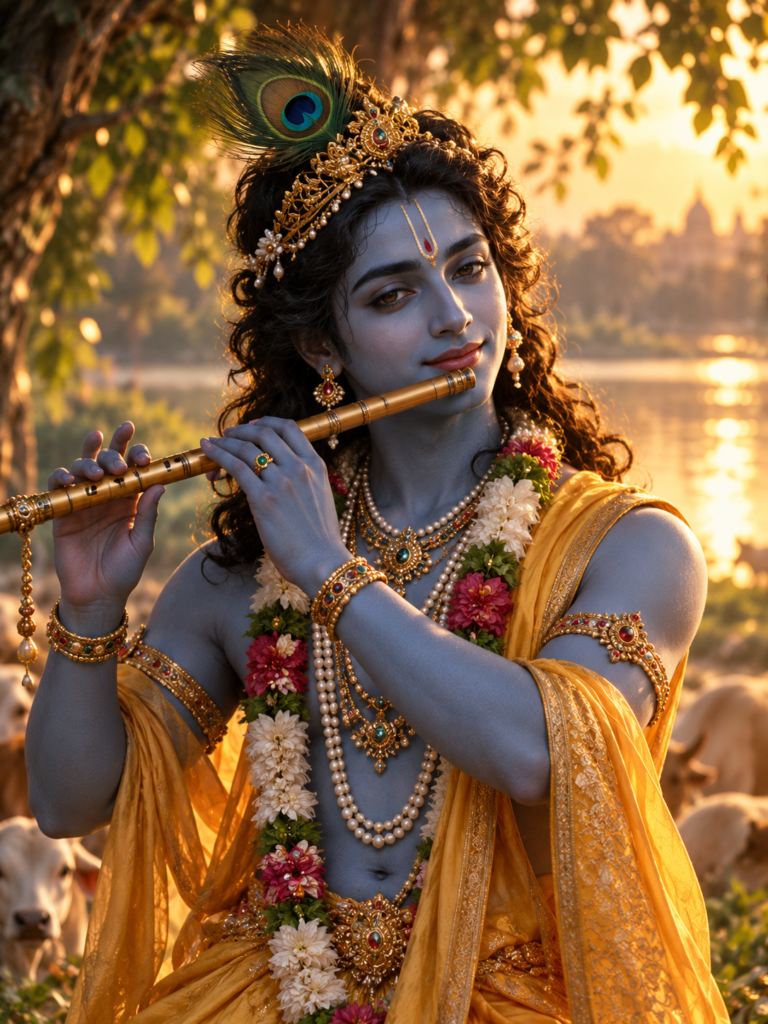 Avatars & formsKrishnaकृष्ण
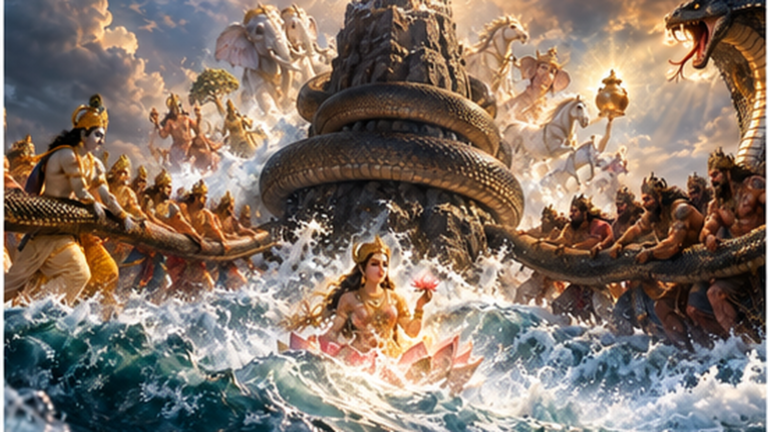 Stories & mythsSamudra Manthanसमुद्र मंथन
 Aartis & mantrasOm Jai Jagdish Hareॐ जय जगदीश हरे
 FestivalsDiwaliदीपावली
 WeaponsSudarshana Chakraसुदर्शन चक्र
 Appears inBhagavata Puranaभागवत पुराण
 Places & templesTirupatiतिरुपति
 ObjectsPanchajanyaपाञ्चजन्य
 AbodeVaikunthaवैकुंठ