Sudarshana Chakra
सुदर्शन चक्रThe Sudarshana Chakra is the spinning discus of Vishnu, held in his upper right hand. It cuts down those who threaten dharma and returns to his finger when its work is done. It severs Rahu's head, frees Gajendra and ends Shishupala, and in South India it is worshipped as the deity Chakrattalvar.
What is the Sudarshana Chakra?
A spinning disc with a serrated edge, described in the Puranas as blazing like the sun. Vishnu releases it against those who threaten dharma, and it returns to his hand once its work is done.
In South Indian Vaishnava temples the chakra is also worshipped as a deity in its own right, as Chakrattalvar or Sudarshana.
The discus in the great stories
Few objects in Hindu tradition appear in as many stories as the Sudarshana Chakra:
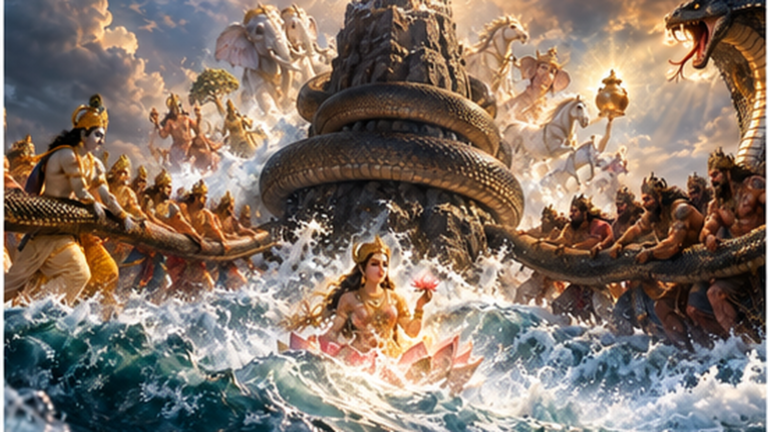
- Rahu and Ketu — During the churning of the ocean, Vishnu as the enchantress Mohini serves the nectar of immortality to the devas. The asura Svarbhanu slips into their line and drinks. The Sun and Moon raise the alarm, and Vishnu severs his head with the discus. Because the nectar had touched his throat, the head lived on as Rahu and the body as Ketu, who swallow the Sun and Moon at eclipses (Bhagavata Purana 8.9).
- Gajendra Moksha — The elephant king Gajendra, seized by a crocodile in a lake, calls on Vishnu with a single lotus held up in his trunk. Vishnu arrives on Garuda and frees him by cutting the crocodile with his discus (Bhagavata Purana 8.2-4).
- Ambarisha and Durvasa — When the irascible sage Durvasa tries to destroy the devoted king Ambarisha, the Sudarshana pursues the sage through every world. Not even Brahma or Shiva can shelter him, and Vishnu sends him back to ask the king’s forgiveness (Bhagavata Purana 9.4-5).
- Shishupala — At Yudhishthira’s Rajasuya sacrifice, Krishna forgives his cousin Shishupala a hundred insults, as he had promised. At the hundred and first, he releases the discus (Mahabharata, Sabha Parva).
- The Shakti Peethas — When Shiva wanders the worlds carrying the body of his wife Sati, Vishnu uses the discus to divide it, and the places where the pieces fall become the Shakti Peethas, the seats of the Goddess (later Puranas such as the Devi Bhagavata and Kalika Purana).
- Jayadratha — In popular retellings of the Kurukshetra war, Krishna hides the setting sun behind his discus so that Arjuna can keep his vow to kill Jayadratha before nightfall.
Sudarshana as a deity
In South Indian Vaishnava temples the discus is worshipped as a god in his own right, Sudarshana or Chakrattalvar, the “discus saint”. He is shown as a fierce, many-armed figure inside a six-pointed star and a wheel of flames, with Yoga Narasimha carved on the back of the same image. Devotees perform the Sudarshana homa, a fire ritual for protection and healing, and recite the Sudarshana Ashtakam of Vedanta Desika.
What does it symbolise?
Tradition reads the spinning disc as the mind, always in motion, and as the wheel of time. Its edge stands for the discernment that cuts through ignorance; its return to Vishnu's hand for power that is never misused.