Kaumodaki
कौमोदकीKaumodaki is the mace (gada) of Vishnu, held in one of his four hands with the discus, conch and lotus. The Mahabharata says the sea god Varuna gave it to Krishna at the burning of the Khandava forest, and the Vishnu Purana reads it as the power of the intellect.
What is the Kaumodaki?
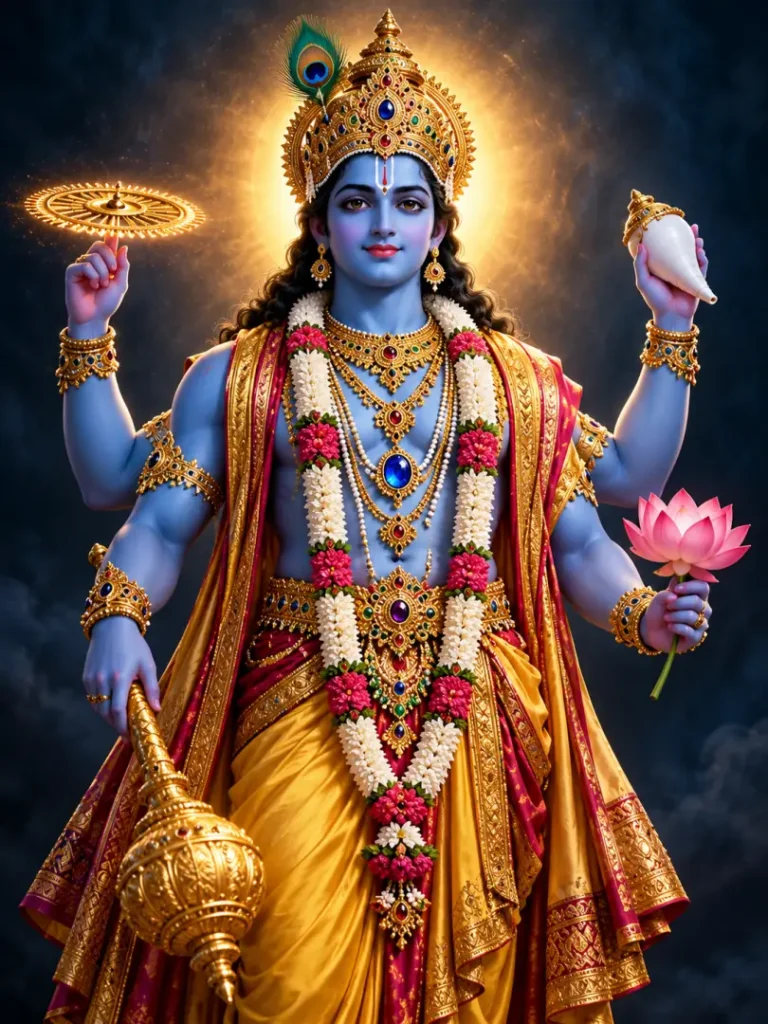
Kaumodaki is the heavy mace, or gada, carried by Vishnu and by his avatar Krishna. It is one of the four emblems that identify Vishnu in temple images, alongside the discus Sudarshana, the conch Panchajanya and the lotus Padma.
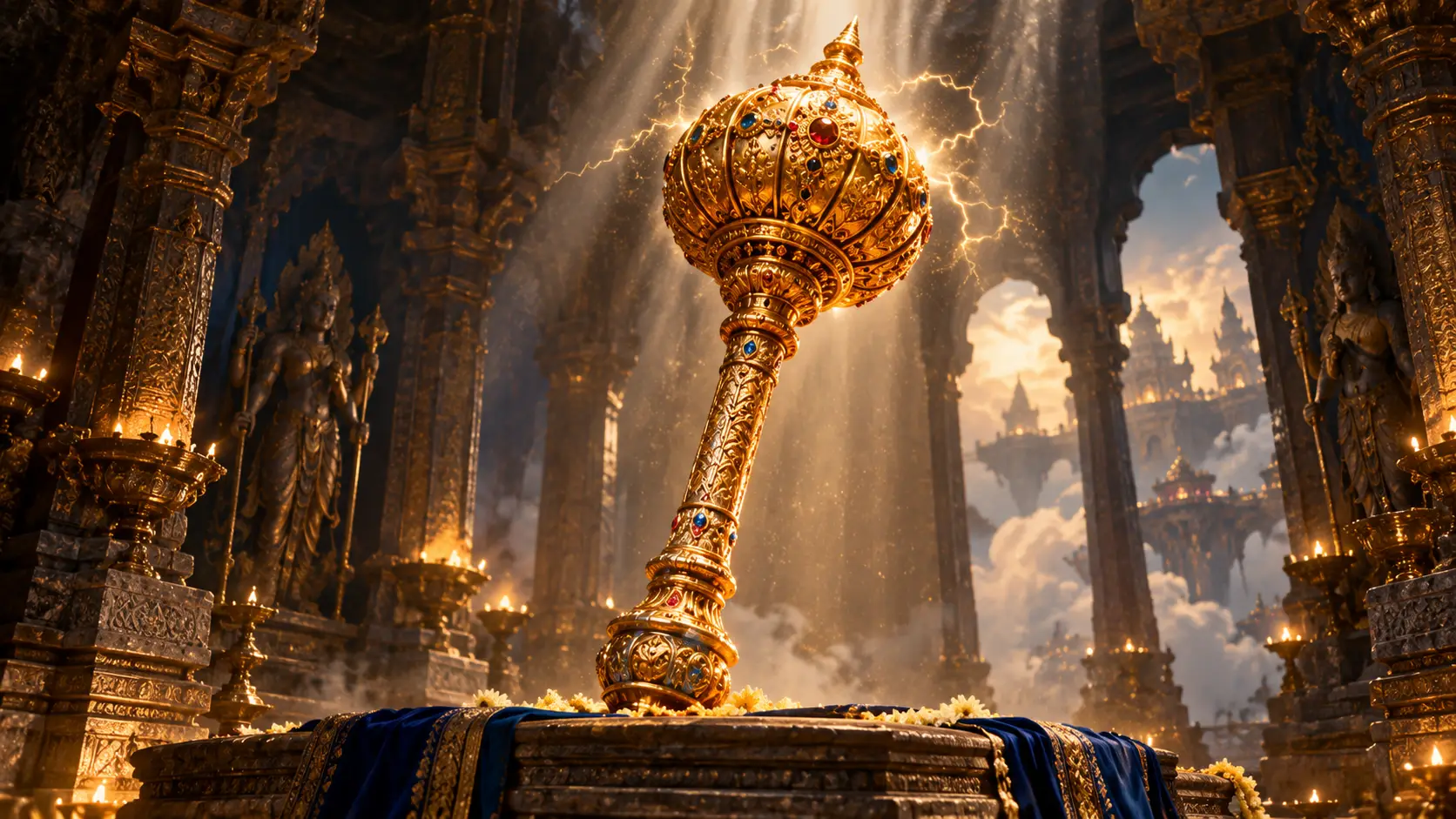
In sculpture it is usually a tall club with a ribbed or faceted head, sometimes resting on the ground under Vishnu's lower hand. In early art it is also shown as a small female figure, Gadadevi, standing beside the god.
Kaumodaki in the hands of Vishnu
In most images of four-armed Vishnu the mace rests in one of the lower hands, its head on the ground or held upright beside his body. Together with the discus Sudarshana, the conch Panchajanya and the lotus, it completes the four emblems by which a sculptor or painter identifies Vishnu at a glance. Because the weapons can move between the four hands, the Agni and Padma Puranas describe twenty-four named arrangements of Vishnu, among them the familiar forms of Keshava, Narayana, Madhava and Govinda, each defined in part by where Kaumodaki is held.
Kaumodaki in the Mahabharata
The mace enters the epic story in the Adi Parva, at the burning of the Khandava forest. Agni, the fire god, asks Krishna and Arjuna to help him consume the forest. To arm them, the sea god Varuna gives Arjuna the bow Gandiva and gives Krishna the discus and the mace Kaumodaki, which the text describes as a weapon whose crash is like thunder. From then on Krishna is called Gadadhara, the bearer of the mace.
Gadadevi: the mace as a goddess
Early Indian art often personified the weapons of Vishnu as small human figures called ayudhapurushas. Sudarshana became Chakrapurusha, a male figure, while Kaumodaki became Gadadevi, a female figure who stands at Vishnu’s side with one hand resting on her head, as in the Gupta-period sculptures of central India. In this form the mace is not only an object but a power that serves the god.
The name
The name is traditionally explained from ku (the earth) and moda (joy): the mace that gladdens the earth, because it protects it. The closing verse of the Vishnu Sahasranama names it among the five weapons of Vishnu, calling him gadādhara, the one who holds the mace.
What does it symbolise?
The Vishnu Purana (1.22) gives each of Vishnu's emblems an inner meaning. There the mace stands for buddhi, the intellect: the faculty that decides, steadies and protects. Read this way, Vishnu holding Kaumodaki shows the mind's power to discriminate, held firmly in the service of…