Garuda
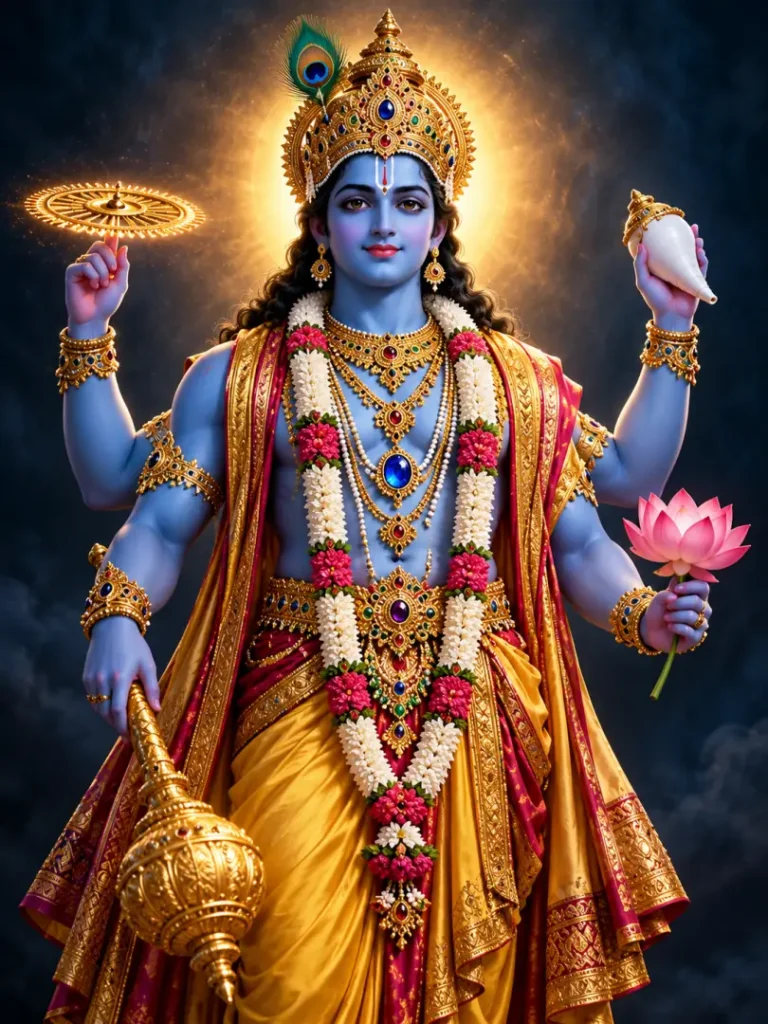
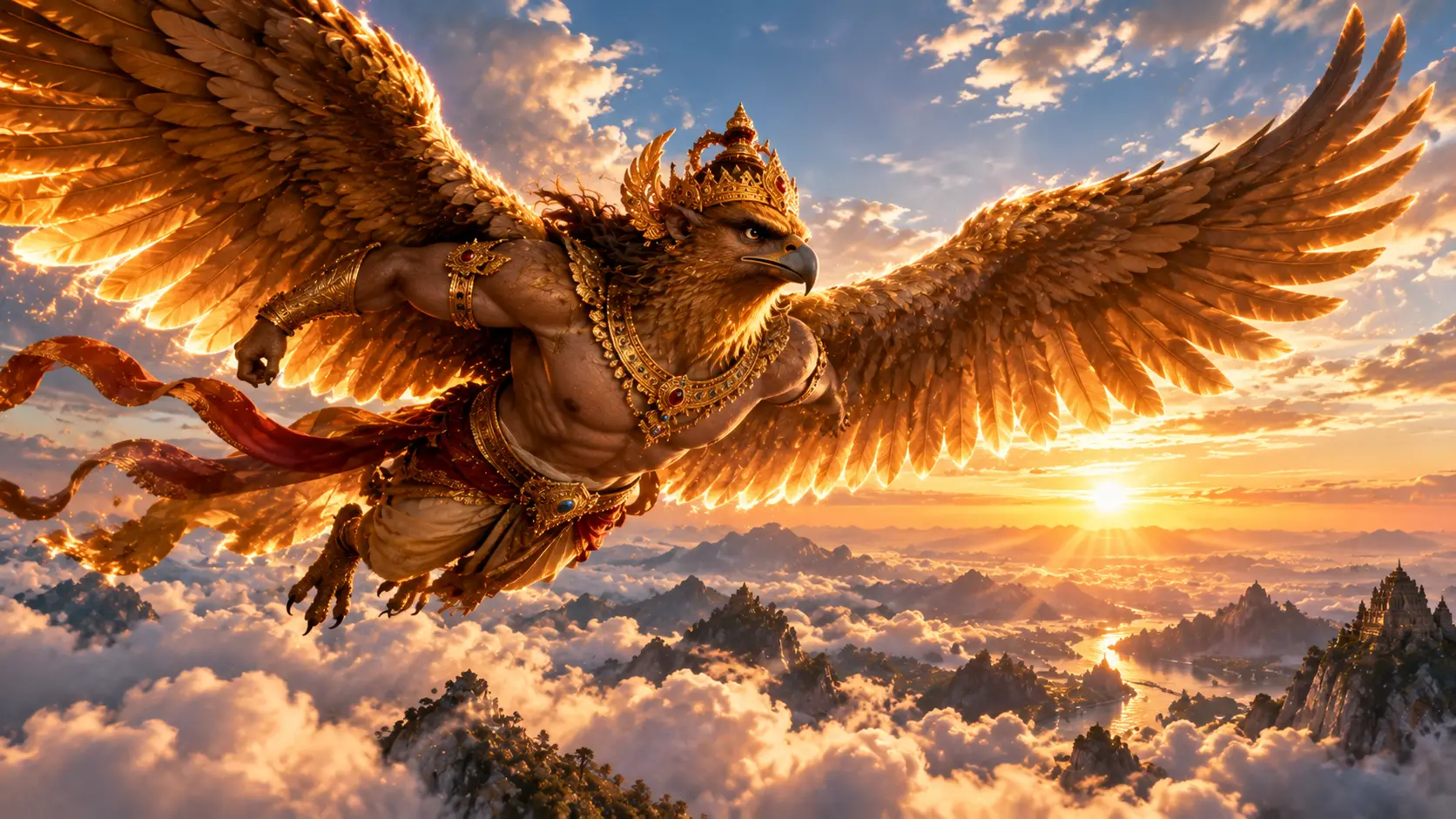
गरुड़Garuda is the king of birds and the mount of Vishnu, with the beak and wings of an eagle. Son of the sage Kashyapa and Vinata, he won the nectar of immortality to free his mother from slavery, and Vishnu made him his vahana. He is the enemy of serpents and the speaker of the Garuda Purana.
What is the Garuda?
Garuda is the divine eagle who serves as Vishnu's mount and banner. He is usually shown as a man with wings and an eagle's beak, kneeling with hands folded before Vishnu, or flying with Vishnu and Lakshmi on his shoulders.
He is also a deity in his own right, worshipped at the entrance of Vishnu temples facing the inner shrine, much as Nandi faces Shiva.
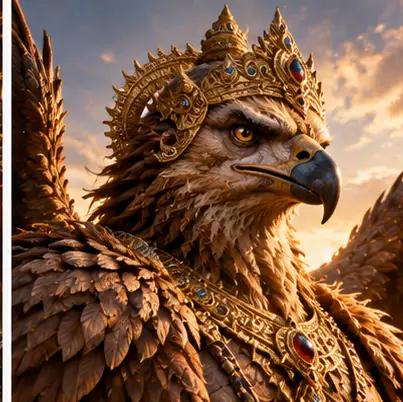
Garuda is the king of birds and the mount (vahana) of Vishnu: a mighty being with the beak, wings and talons of an eagle and, in many images, the body of a man. He carries Vishnu across the worlds, flies on his banner, and is himself worshipped as a great devotee.
Birth and the quest for amrita
The Mahabharata (Adi Parva) tells Garuda’s story at length. The sage Kashyapa had two wives, the sisters Vinata and Kadru. Kadru asked for a thousand serpent sons; Vinata asked for two sons who would be greater than all of them. Kadru’s eggs hatched first, and Vinata, impatient, broke one of hers early: the half-formed son, Aruna, became the charioteer of the Sun and cursed her to be a slave. Through a trick about the colour of the divine horse Uchchaihshravas’s tail, Kadru made Vinata her servant.
When Garuda hatched, blazing like fire, he asked the serpents what would free his mother. They demanded the amrita, the nectar of immortality, kept by the gods. Garuda flew to heaven, overcame its guardians, passed through a spinning wheel of blades and two fire-breathing serpents, and seized the nectar without tasting it. Vishnu, moved by his lack of greed, granted him immortality and asked him to be his mount. Indra, whose thunderbolt could not harm him, became his friend. Garuda gave the nectar to the serpents and so freed his mother, but Indra took it back before they could drink, and the serpents only licked the grass where it had rested, which is why snakes have forked tongues.
Garuda and the serpents
From that day Garuda and the nagas have been enemies, and Garuda is invoked against snake bite and poison. The Garuda Purana, the Purana that bears his name, is a dialogue between Vishnu and Garuda; its later section on death and the journey of the soul is read in many homes during the days of mourning.
Garuda in the epics and beyond
In the Ramayana Garuda frees Rama and Lakshmana from the serpent-arrows (nagapasha) of Indrajit. In the Bhagavata, Vishnu rides him to rescue the elephant Gajendra. The Heliodorus Pillar at Besnagar, set up around 110 BCE by a Greek envoy, is a Garuda column dedicated to Vasudeva, one of the earliest inscriptions of Vishnu devotion. Garuda is the national emblem of Indonesia and Thailand, and appears as Garuda Indonesia’s name and as the Karura of Japanese Buddhism.
What does it symbolise?
Tradition reads Garuda as the Vedas themselves, on whose wings the divine is carried into the world, and his flight as the speed with which God answers a devotee's call. His victory over the serpents makes him the protector against poison, fear and the bondage…