Brahma
ब्रह्माThe creator of the worlds. Also called Svayambhu, Prajapati, Pitamaha, Hiranyagarbha, Chaturmukha, Kamalasana, Vidhata, Vedanatha.
Brahma is the creator god of Hinduism and the first of the Trimurti. Four-faced and seated on a lotus that grows from Vishnu's navel, he gave the world its forms and the four Vedas, with Saraswati as his consort and the swan Hamsa as his mount. His most famous temple is at Pushkar.
Who is Brahma?
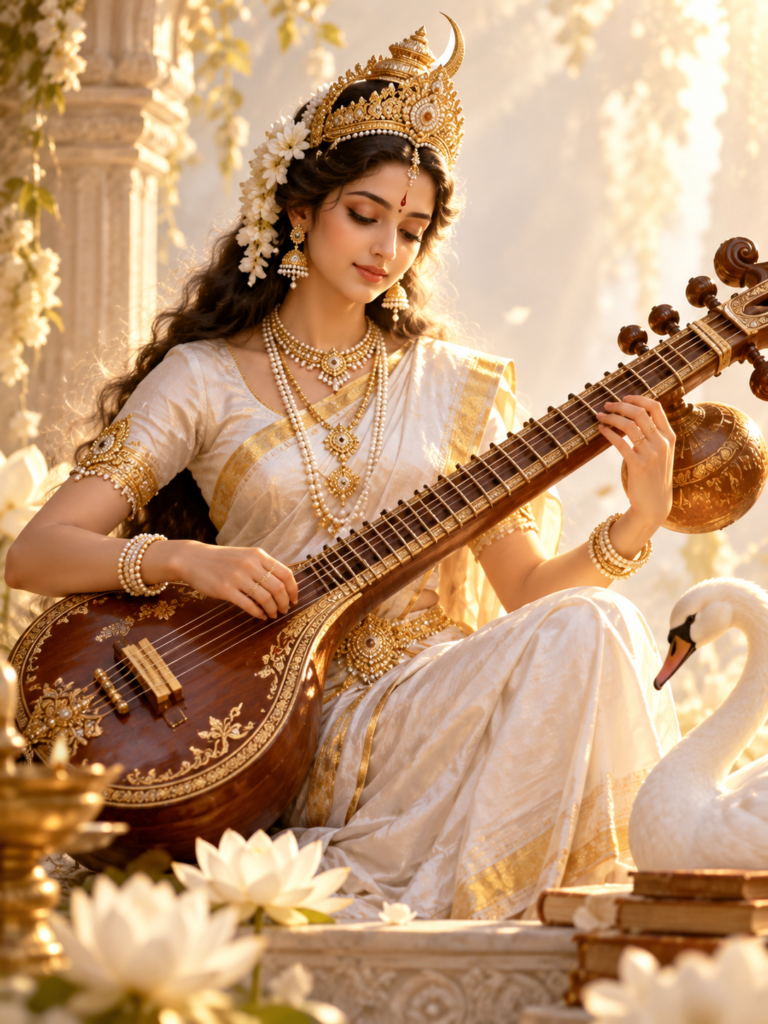
Brahma (Sanskrit: ब्रह्मा, Brahmā) is the creator god of Hinduism and the first of the Trimurti, with Vishnu the preserver and Shiva the destroyer. He is pictured as a wise, bearded elder with four faces looking in the four directions, seated on a lotus, holding the Vedas, and riding the swan Hamsa. His consort is Saraswati, the goddess of knowledge, because creation needs knowledge to take form.
Brahma appears constantly in the Puranas and epics, granting boons to sages and demons alike and setting the stage for many of the great stories, yet he has very few temples. The most famous is at Pushkar in Rajasthan.
Brahma and Brahman: not the same
The names sound alike but mean different things. Brahman (a neuter word) is the ultimate, formless reality of the Upanishads, beyond all gods. Brahma (masculine) is a personal god with a form, a family and a role: the creator of the worlds within a cycle of time. Some scholars suggest Brahma emerged as a visible image of the impersonal Brahman. In Vedic ritual, Brahma was identified with Prajapati, the lord of creatures, and with Hiranyagarbha, the golden womb from which the universe arose (Rigveda 10.121).
How was Brahma born?
The texts give several accounts, each reflecting the tradition that tells it:
- From the lotus of Vishnu’s navel — In the Vaishnava Puranas, Vishnu sleeps on Shesha in the cosmic ocean, and a lotus grows from his navel. Brahma appears on it, sees nothing around him, and meditates until he understands his task. This is why he is called Kamalasana (seated on the lotus) and Nabhija (born from the navel).
- From the golden egg — The Brahmanda Purana and the Manusmriti describe a primeval ocean in which a golden egg (Hiranyagarbha) floated for a year; Brahma, born within it, split it into heaven and earth. He is therefore Svayambhu, the self-born.
- From Shiva — Shaiva texts say Brahma and Vishnu were born from Shiva’s right and left sides; Shakta texts say the Goddess brought forth all three gods.
How does Brahma create?
Brahma is a secondary creator: he does not make the raw stuff of the universe, which comes from a higher reality, but shapes it into worlds, beings and time. The Bhagavata Purana (Book 3, ch. 12) tells that he first created four boy-sages, the Kumaras (Sanaka, Sanandana, Sanatana and Sanatkumara), who refused to marry and have children and chose to remain celibate seekers of truth. Brahma’s anger at this took the form of Rudra. He then created the mind-born sons, the manasaputras, who became the progenitors of all beings, among them Marichi, Atri, Angiras, Pulastya, Pulaha, Kratu, Vasishtha, Bhrigu, Daksha and Narada, and from his own body the first man and woman, Svayambhuva Manu and Shatarupa.
Brahma’s four heads and the lost fifth head
Brahma’s four faces are said to have produced the four Vedas, one from each mouth, and to watch over the four directions. The Matsya Purana tells that he once had a fifth head, which grew when he could not take his eyes off Shatarupa, the woman he had created. In the Shiva Purana, the fifth head is cut off by Shiva, in his fierce form as Bhairava, when Brahma speaks arrogantly; the skull clings to Bhairava’s hand until he reaches Varanasi.
Why is Brahma rarely worshipped?
Tradition gives several stories:
- The pillar of light — Brahma and Vishnu quarrelled over who was greater. An endless column of fire appeared. Vishnu, as a boar, searched for its base; Brahma, as a swan, flew to find its top. Neither succeeded, but Brahma claimed he had, and brought a ketaki flower as a false witness. Shiva emerged from the pillar and declared that Brahma would receive little worship, and the ketaki flower is not offered to Shiva (Shiva Purana).
- Savitri’s curse — When Brahma performed a sacrifice at Pushkar and his wife Savitri was late, he married Gayatri to complete the rite; Savitri cursed that he would be worshipped only at Pushkar (Padma Purana).
- Bhrigu’s curse — The sage Bhrigu, testing which god was the greatest, felt slighted by Brahma and cursed him not to be worshipped.
Historians add that as Shaiva and Vaishnava devotion grew in the first millennium, the creator, whose work was done, faded from temple worship while remaining honoured in ritual and story.
The lifespan of Brahma and the cycles of time
Hindu cosmology measures time on Brahma’s scale. One day of Brahma, a kalpa, lasts 1,000 cycles of the four yugas, about 4.32 billion human years; his night is equally long, and in it the worlds rest in dissolution. Brahma lives for a hundred years of such days, a total of 311.04 trillion years, after which he too dissolves and a new Brahma arises. Traditional reckoning says we are now in the first day of the fifty-first year of the present Brahma’s life, in the Shveta Varaha kalpa, in the seventh Manvantara, that of Vaivasvata Manu, in the twenty-eighth Kali Yuga. Brahma’s own world, the highest of the worlds of the universe, is Brahmaloka, also called Satyaloka.
Brahma in the stories
- The boons — Brahma grants boons to anyone who performs enough penance, demons included. Hiranyakashipu won near-immortality, which Vishnu overcame as Narasimha; Ravana was made invulnerable to gods and demons but did not think to ask protection from men and monkeys; and when Kumbhakarna meant to ask for Indra’s throne (Indrasana), Saraswati twisted his tongue and he asked for endless sleep (Nidrasana).
- The Ramayana itself — In the Bala Kanda, after Valmiki speaks the first shloka in grief at the death of a krauncha bird, Brahma appears to him and asks him to compose the story of Rama in that metre.
- Brahma and the cowherd boys — In the Bhagavata Purana (10.13), Brahma hides Krishna’s cowherd friends and calves for a year to test him. Krishna becomes every boy and every calf himself, and Brahma, humbled, sings his praise.
- The Brahmastra — The most powerful divine weapon in the epics is named after him and invoked with his mantra.
Brahma beyond Hinduism
In Buddhism, Brahma Sahampati appears to the newly awakened Buddha and urges him to teach the world; the scene is told in the Pali canon. The Erawan Shrine in Bangkok, with its four-faced golden image, is one of the most visited shrines in Thailand, and the 9th-century Prambanan complex in Java has a temple to Brahma beside those of Shiva and Vishnu.
Where is Brahma worshipped?
- Jagatpita Brahma Mandir, Pushkar — the best-known Brahma temple, beside the sacred lake.
- Asotra, Rajasthan — the Shri Kheteshwar Brahmadham temple.
- Khedbrahma, Gujarat, and Brahma Kuti at Bithoor, Uttar Pradesh.
- Kumbakonam, Tamil Nadu, and the Brahmapureeswarar temple at Thirupattur, where Brahma is said to have regained his powers by worshipping Shiva.
- Brahma’s image also stands in the niche on the north wall of many South Indian Shiva temples.
हिरण्यगर्भः समवर्तताग्रे भूतस्य जातः पतिरेक आसीत्।
In the beginning arose the golden womb, Hiranyagarbha; once born, he was the one lord of all that exists.