
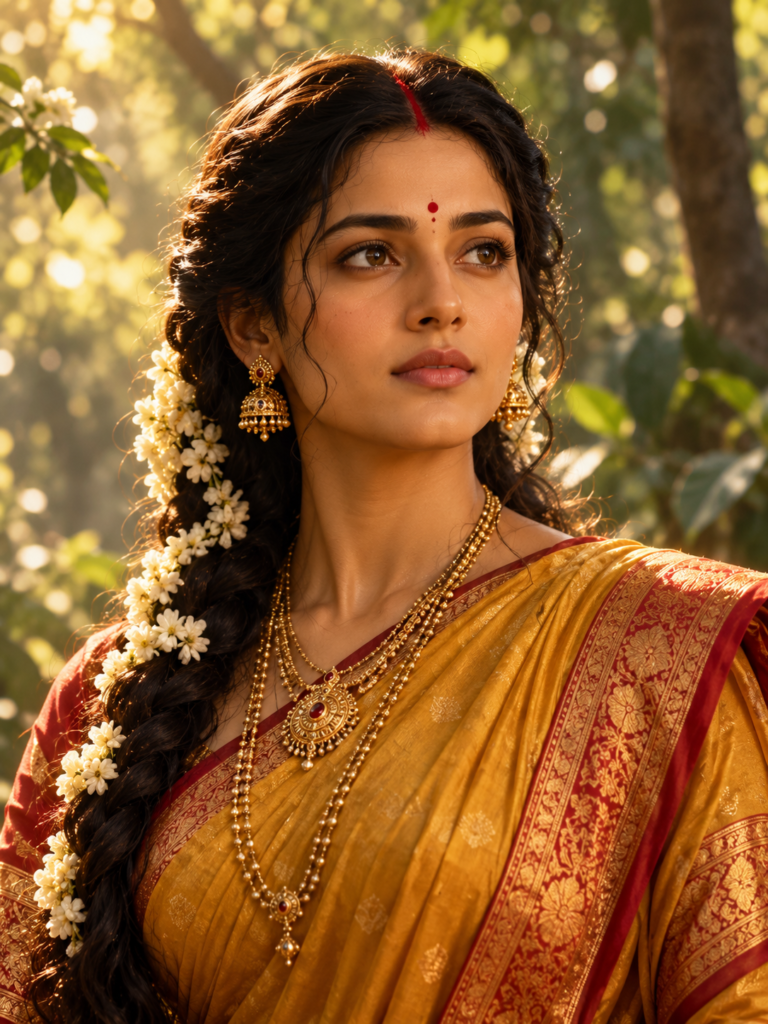
Sita
सीताPrincess of Mithila, queen of Ayodhya; wife of Rama. Also called Janaki, Vaidehi, Maithili, Bhumija, Siya, Janakanandini.
Sita, found in a furrow by King Janaka of Mithila, married Rama when he broke Shiva's bow and followed him into exile. Carried off to Lanka by Ravana, she resisted him in the Ashoka grove until Rama's victory. She is honoured as a form of Lakshmi and a model of courage.
Who was Sita?
Sita (सीता) is the heroine of the Ramayana, the wife of Rama and, for devotees, a form of the goddess Lakshmi. Her courage, loyalty and dignity under trial have made her one of the most revered women in Indian tradition, and the pairing “Sita-Ram” puts her name first.
Daughter of the earth
King Janaka of Mithila, ploughing a field to prepare for a sacrifice, found a baby girl in the furrow. He named her Sita, “the furrow”, and raised her as his daughter. She is therefore called Bhumija and Bhumisuta, born of the earth, and also Janaki (daughter of Janaka), Maithili (of Mithila) and Vaidehi (of Videha). Janakpur in Nepal and Sitamarhi in Bihar both honour her birthplace.
Marriage and exile
Janaka promised Sita’s hand to whoever could string the great bow of Shiva. Rama broke it, and they married. When Rama was exiled, Sita refused to stay behind in the palace, telling him that a wife’s place was at her husband’s side, and walked into the forest with him and Lakshmana. Their years at Chitrakoot and Panchavati are remembered as the happiest of the epic.
Captive in Lanka
At Panchavati Sita saw a golden deer and asked Rama to catch it. It was the demon Maricha in disguise, sent by Ravana. When Rama and then Lakshmana had gone, Ravana came disguised as a wandering ascetic and carried her off in his flying chariot; the old vulture Jatayu died trying to stop him. In Lanka Sita was kept in the Ashoka grove for months. She refused every threat and temptation, holding a blade of grass between herself and Ravana as she spoke to him. Hanuman found her there, gave her Rama’s ring, and took back her hair jewel, the chudamani, as a token. The kind rakshasi Trijata comforted her.
The fire ordeal and the return to the earth
After the war Sita passed through fire, the Agni Pariksha, and Agni himself returned her unharmed, declaring her purity. In the Uttara Kanda, after Rama’s return to Ayodhya, public gossip led him to send the pregnant Sita away. The sage Valmiki gave her shelter, and there she raised the twins Lava and Kusha. When at last she was asked to prove her purity once more, she called on her mother the Earth, which opened and took her back. Many later poets, and many readers today, have found in these episodes the epic’s deepest sorrow, and retellings such as the Adbhuta Ramayana give Sita far greater power, as the Goddess who slays a thousand-headed Ravana.
How is Sita honoured?
Sita is worshipped with Rama in every Rama temple. Sita Navami (Vaishakha Shukla Navami) marks her appearance, and Vivah Panchami, especially at Janakpur, her wedding.
Connected to Sita
 Appears inRamayanaरामायण
 Stories & mythsThe Breaking of Shiva’s Bowशिव धनुष भंग
 Places & templesPanchavati, Nashikपंचवटी, नासिकStories & mythsSita’s Agni Parikshaसीता की अग्नि परीक्षाStories & mythsLava and Kusha: Sita’s Sons and Her Return to the Earthलव-कुश: सीता के पुत्र और पृथ्वी में लीन होना
 Stories & mythsThe Golden Deer and the Abduction of Sitaस्वर्ण मृग और सीता हरण
 Places & templesAyodhyaअयोध्या
 Stories & mythsHanuman’s Leap to Lankaहनुमान की लंका यात्रा
 ConsortRamaरामRelated figuresUrmilaऊर्मिला