Shesha
शेषShesha, also called Adishesha and Ananta, is the thousand-hooded king of serpents on whose coils Vishnu rests in the ocean of milk. He holds the earth on his hoods, stands for time that remains after dissolution, and is born on earth as Lakshmana and Balarama.
What is the Shesha?
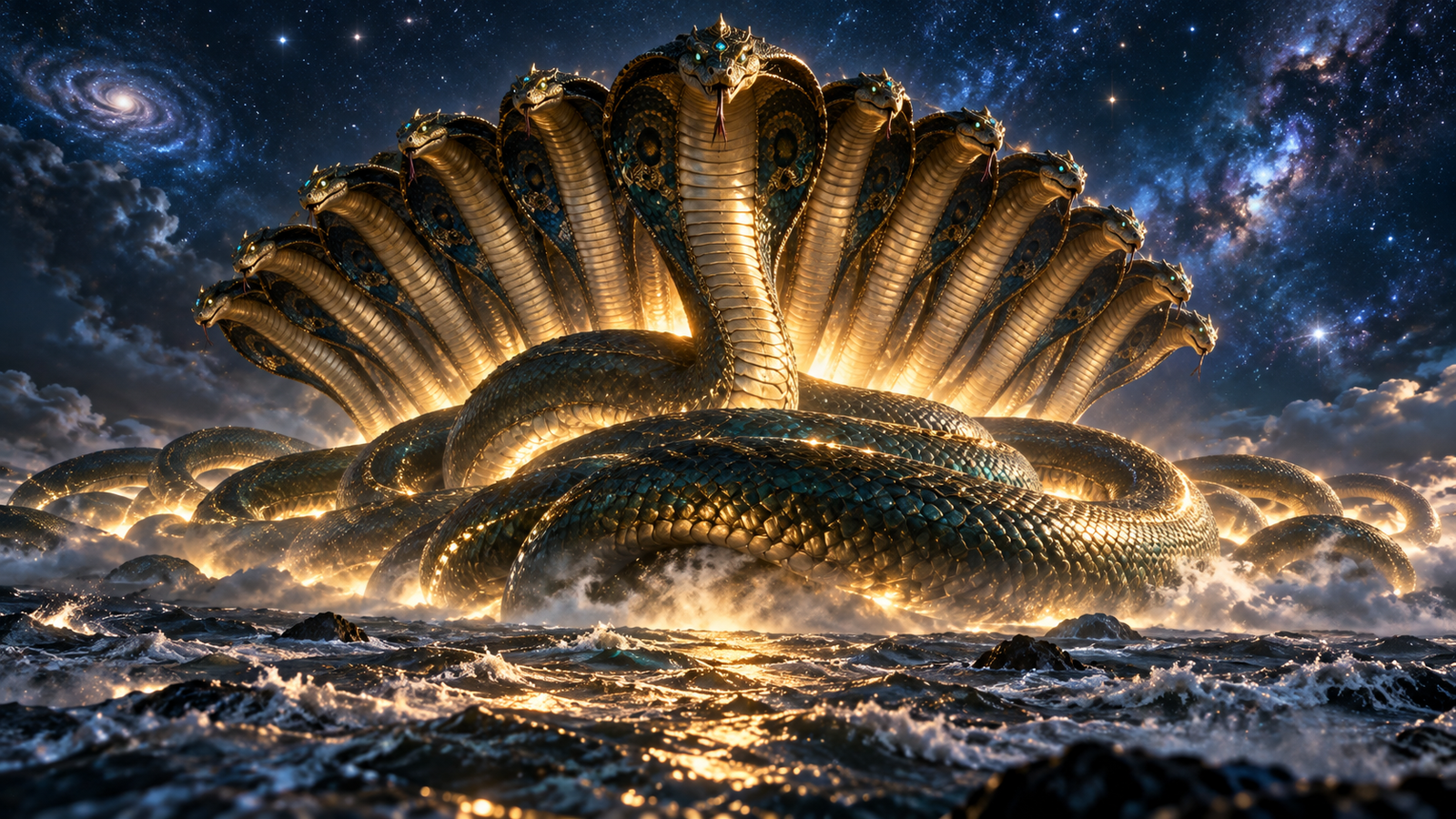
Shesha is the cosmic serpent who forms Vishnu's couch, coiled upon the ocean of milk with his many hoods spread above the god's head. He is usually shown with five, seven or a thousand hoods, pale or white in colour.
He is counted among Vishnu's eternal companions in Vaikuntha, and as the bearer of the earth he is sometimes shown beneath the world itself.
Shesha, also called Adishesha (the first Shesha) and Ananta (the endless), is the king of serpents and the great naga on whose coils Vishnu rests in the cosmic ocean. His thousand hoods rise over Vishnu like a canopy, and in many accounts the whole earth rests on one of his heads.
Birth and penance
Like the other nagas, Shesha is a son of the sage Kashyapa and Kadru. The Mahabharata (Adi Parva) says that he turned away from his quarrelsome brothers and went to do penance on the mountains. Pleased, Brahma asked him to hold the earth steady upon his head, and Shesha went beneath the earth to do so. When he yawns, it is said, the earth trembles.
The couch of Vishnu
Between the cycles of creation, Vishnu lies upon Shesha in yoga-nidra on the ocean of milk, as Anantashayana or Sheshashayi Vishnu. The name Shesha means “the remainder”: he is what remains when everything else has dissolved, which is why tradition reads him as time itself, continuing when the worlds are gone. This image is carved in famous temples: Padmanabhaswamy in Thiruvananthapuram, Ranganathaswamy in Srirangam, and the 6th-century Vishnu Anantashayana panel at the Dashavatara temple in Deogarh.
Shesha on earth
Shesha accompanies Vishnu in his avatars. He is born as Lakshmana, Rama’s devoted younger brother, and as Balarama, Krishna’s elder brother. The grammarian Patanjali, author of the Yoga Sutras, is also honoured as an incarnation of Adishesha, and the Sri Vaishnava teacher Ramanujacharya is held to be another. At the end of each cycle the Puranas say that the fire of dissolution issues from Shesha’s mouths.
What does it symbolise?
The name Shesha means the remainder: what is left when all else has dissolved. Tradition therefore reads him as time and as the endless support of the universe, and Ananta, the endless, as infinity. His service as Vishnu's bed, shade and seat makes him the…
