The Ramayana, in full
The Ramayana (रामायण, “the journey of Rama”) is one of the two great Sanskrit epics of India, together with the Mahabharata. It tells the life of Rama, prince of Ayodhya and the seventh avatar of Vishnu: his youth and marriage to Sita, his fourteen years of exile in the forest, Sita’s abduction by Ravana, king of Lanka, the alliance with Hanuman and the vanaras, the war to win her back, and his reign as the ideal king. Tradition calls it the Adi Kavya, the first poem, and its author Valmiki the Adi Kavi, the first poet.
In its oldest form, the Valmiki Ramayana, it runs to about 24,000 verses in seven books (kandas). But the Ramayana is not one text: it has been retold hundreds of times, in almost every language of South and Southeast Asia, in poetry, drama, dance, puppetry, painting, temple sculpture and television. Few stories have shaped the moral imagination of so many people for so long.
The story of the Ramayana, book by book
1. Bala Kanda: childhood and marriage
King Dasharatha of Ayodhya, of the Ikshvaku or Sun dynasty, had three queens, Kausalya, Kaikeyi and Sumitra, but no children. On the advice of his ministers he performed the putrakameshti sacrifice, and from the fire rose a divine being carrying a bowl of sweet payasam. The queens shared it, and four sons were born: Rama to Kausalya, Bharata to Kaikeyi, and the twins Lakshmana and Shatrughna to Sumitra. Meanwhile the gods, oppressed by Ravana, had prayed to Vishnu, who promised to be born as a man, since Ravana had asked for protection from every being except humans.
When Rama was sixteen, the sage Vishwamitra asked for him to protect his sacrifice from the rakshasas. Rama and Lakshmana went with him, killed the demoness Tataka, drove off Maricha and Subahu, and received divine weapons from the sage. On the way to Mithila, Rama freed Ahalya from her curse. In King Janaka’s court he lifted and broke the bow of Shiva and won Sita, Janaka’s daughter, found in a furrow of the earth. The four brothers married four princesses of Mithila on the same day.
2. Ayodhya Kanda: the exile
Dasharatha, growing old, decided to crown Rama as heir. On the eve of the coronation, Kaikeyi’s maid Manthara poisoned her mind, and Kaikeyi claimed two boons the king had once promised her for saving his life in battle: that Bharata be crowned, and that Rama be sent into the forest for fourteen years. Bound by his word, the king could not refuse. Rama accepted calmly; Sita insisted on going with him, and Lakshmana would not leave his brother. Dasharatha died of grief, remembering a curse laid on him long ago when he had killed the young ascetic Shravana Kumara by mistake.
Bharata, returning from his uncle’s kingdom, was horrified. He refused the throne, went to Chitrakoot to beg Rama to return, and when Rama would not break his father’s word, carried his sandals (paduka) back to Ayodhya and ruled from the village of Nandigram as Rama’s servant.
3. Aranya Kanda: the forest
The exiles wandered for years through the hermitages of the Dandaka forest, protecting the sages from rakshasas and meeting Atri and Anasuya, Sharabhanga, Sutikshna and Agastya, who gave Rama divine weapons. They settled at Panchavati on the Godavari. There Ravana’s sister Shurpanakha tried to win Rama and, mocked and attacking Sita, lost her nose and ears to Lakshmana. Rama destroyed the army of her brothers Khara and Dushana. In revenge Ravana sent Maricha disguised as a golden deer, lured Rama and Lakshmana away, and carried Sita off to Lanka in his flying chariot Pushpaka. The vulture Jatayu died trying to stop him. Searching for her, the brothers met the headless demon Kabandha and the devoted Shabari, who sent them to Sugriva.
4. Kishkindha Kanda: the vanara kingdom
At Lake Pampa, near Kishkindha, Rama met Hanuman, minister of the exiled vanara prince Sugriva, and swore friendship with Sugriva before a sacred fire. Rama killed Sugriva’s brother Vali, who had taken his kingdom and wife, shooting him from behind a tree while the two brothers fought; the act is among the most debated in the epic. Sugriva was crowned, and after the monsoon the vanara armies set out in four directions. The southern party under Angada, with Hanuman and Jambavan, reached the sea, and learned from Jatayu’s brother Sampati that Sita was in Lanka.
5. Sundara Kanda: Hanuman in Lanka
Hanuman leapt the ocean, searched the golden city by night and found Sita in the Ashoka grove, guarded by rakshasis and refusing Ravana’s threats. He gave her Rama’s ring, received her hair jewel, destroyed the grove, killed Ravana’s son Akshaya, and, when his tail was set on fire, burned Lanka before flying back with the news. The Sundara Kanda is so loved that it is recited on its own as a prayer.
6. Yuddha Kanda: the war
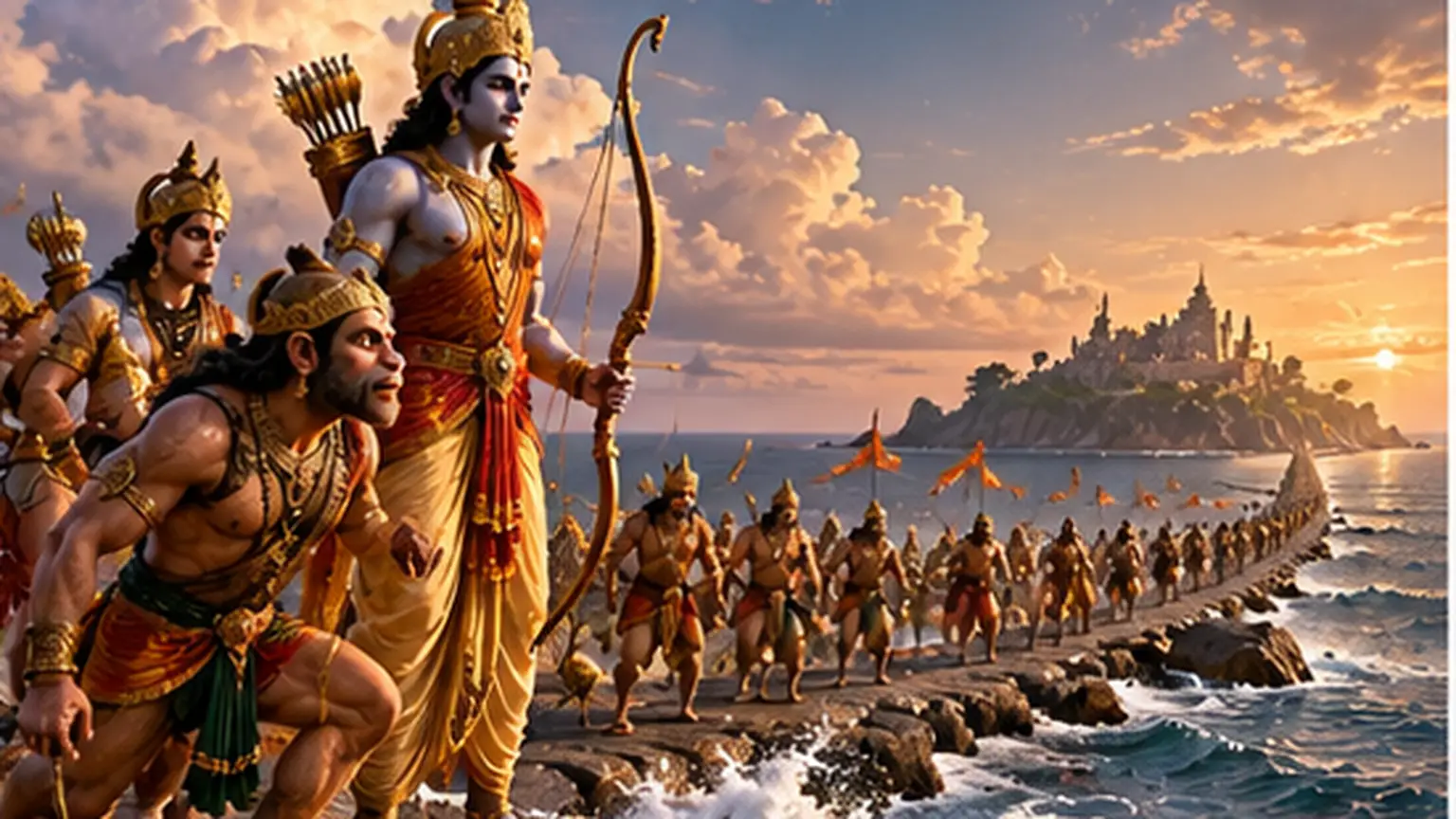
Rama marched to the southern shore. Ravana’s brother Vibhishana, banished for advising him to return Sita, came over to Rama and was given refuge. When the Ocean would not let them pass, Rama threatened it with his arrows; the Ocean rose and told him that Nala could build a bridge, and the vanaras built the Rama Setu in five days. Then came the war. Rama and Lakshmana were bound by Indrajit’s serpent arrows and freed by Garuda; Lakshmana was struck down by Indrajit’s spear and saved when Hanuman brought the mountain of healing herbs; the giant Kumbhakarna was woken and killed; Indrajit fell to Lakshmana. At last Rama, riding Indra’s chariot and strengthened by the Aditya Hridayam hymn taught by Agastya, killed Ravana with the Brahmastra. Vibhishana was crowned king of Lanka. Sita passed through fire to prove her purity before the world, and Agni returned her unharmed. The fourteen years were over, and they flew home to Ayodhya in Pushpaka, where Rama was crowned.
7. Uttara Kanda: the reign and its sorrow
The last book tells the earlier history of Ravana and Hanuman and the long, just reign of Rama, Rama Rajya. But when Rama heard that his people were gossiping about Sita’s years in Ravana’s house, he sent her, pregnant, into the forest. She took refuge in Valmiki’s hermitage, where she gave birth to the twins Lava and Kusha. Valmiki taught them the Ramayana, and they sang it at Rama’s horse sacrifice. Rama recognised his sons and asked Sita to prove her purity once more; instead she called on her mother, the Earth, who opened and took her back. In time Rama, Bharata and Shatrughna entered the Sarayu river and returned to the form of Vishnu.
Valmiki and the birth of poetry
The Ramayana tells its own origin. The sage Narada told Valmiki the story of Rama, the most virtuous man in the world. Soon after, walking by the Tamasa river, Valmiki saw a hunter shoot one of a pair of courting krauncha birds (sarus cranes), and as its mate cried, his grief burst out in a curse that took the form of a perfectly measured verse, mā niṣāda. This was the first shloka: shoka, grief, had become shloka, verse. Brahma appeared and told him to tell the whole story of Rama in this metre. A popular later tradition, not in Valmiki’s text, says that Valmiki had been a highway robber named Ratnakara who was transformed by repeating the name of Rama.
When was the Ramayana composed?
Tradition places Rama in the Treta Yuga, long before the Mahabharata. Historians date the composition of the Valmiki Ramayana in stages: an oral core of Books 2 to 6 perhaps from around the 7th to 5th centuries BCE, with the text largely taking its present form between roughly the 5th century BCE and the 1st to 3rd centuries CE. Many scholars regard the Bala Kanda and Uttara Kanda as later additions, partly because they present Rama more explicitly as an avatar of Vishnu. The text survives in northern and southern recensions; the Critical Edition prepared by the Oriental Institute of Baroda (1960 to 1975) reconstructs the oldest common text.
Themes and ideas
- Dharma: every major character faces a choice between duties: Rama between his own right to the throne and his father’s word, Bharata between kingship and loyalty, Vibhishana between his brother and righteousness. The Ramayana is above all a meditation on dharma.
- The ideal person: Rama is Maryada Purushottam, the best of men who keeps every bound. Sita, Lakshmana, Bharata and Hanuman are ideals of the wife, the brother and the devotee.
- Devotion: Hanuman’s service, Shabari’s berries, Guha the boatman and the squirrel at the bridge made the Ramayana the great text of bhakti to Rama.
- Refuge: Rama’s vow never to refuse anyone who seeks his protection, spoken when Vibhishana arrives, is central to the Sri Vaishnava teaching of surrender (sharanagati).
- Hard questions: the killing of Vali, Sita’s trial by fire and her later banishment, and the killing of the ascetic Shambuka in the Uttara Kanda have been argued over for centuries, and many retellings change or soften them.
Versions of the Ramayana
The scholar A. K. Ramanujan famously wrote of “three hundred Ramayanas”. Every region and tradition has its own telling, often with different details and emphases.
In India
- Sanskrit: besides Valmiki, the Adhyatma Ramayana (part of the Brahmanda Purana) presents Rama openly as the supreme being; the Yoga Vasistha, the Ananda Ramayana and the Adbhuta Ramayana (in which Sita destroys a thousand-headed Ravana), and Kalidasa’s Raghuvamsha and Bhavabhuti’s play Uttararamacharita.
- Tamil: Kambar’s Ramavataram (Kamba Ramayanam, 12th century), a masterpiece in which Rama and Sita first glimpse each other before the bow is broken.
- Telugu: the Ranganatha Ramayanam (13th century) and Molla’s Molla Ramayanam (16th century).
- Kannada: the Jain Pampa Ramayana of Nagachandra and the Torave Ramayana of Narahari.
- Malayalam: Ezhuthachan’s Adhyatma Ramayanam Kilippattu (16th century), read in Kerala homes through the month of Karkidakam, called the Ramayana month.
- Bengali: Krittibas Ojha’s Krittivasi Ramayan (15th century).
- Assamese: Madhava Kandali’s Saptakanda Ramayana (14th century), one of the earliest translations into a modern Indian language.
- Odia: Balarama Dasa’s Jagamohana Ramayana (16th century).
- Marathi: Eknath’s Bhavartha Ramayana (16th century).
- Hindi/Awadhi: Tulsidas’s Ramcharitmanas (1574 onward), the most widely read and sung Ramayana in North India, the text of the Ramlila.
- Kashmiri, Gujarati, Punjabi, Urdu, Persian: among many others, a Persian translation was made at Akbar’s court.
Jain and Buddhist tellings
The Jain Paumachariya of Vimalasuri (in Prakrit) makes Ravana a tragic and noble figure, and it is Lakshmana, not Rama, who kills him, since Rama, a Jain ideal, does no violence. The Buddhist Dasaratha Jataka tells a shorter story in which Rama is an earlier birth of the Buddha and there is no abduction or war.
Across Asia
- Thailand: the Ramakien, whose hero Phra Ram is a model for the Thai kings, all named Rama in the current dynasty; its murals line the Temple of the Emerald Buddha in Bangkok.
- Cambodia: the Reamker, carved on the walls of Angkor Wat and danced by the royal ballet.
- Indonesia: the Old Javanese Kakawin Ramayana (9th century) and the reliefs of Prambanan; the story is performed in wayang kulit shadow puppetry and in Balinese kecak dance.
- Malaysia: the Hikayat Seri Rama.
- Laos: the Phra Lak Phra Lam.
- Myanmar: the Yama Zatdaw.
- Philippines: the Maranao Maharadia Lawana.
- Nepal, Tibet, China, Japan: retellings reached these lands through Buddhist texts and traders.
The Ramayana in living culture
The Ramayana is not only read; it is lived. The Ramlila, a dramatic re-enactment of the story over ten or more nights, is performed across North India during Navratri, ending at Dussehra with the burning of Ravana’s effigy; the Ramlila of Ramnagar near Varanasi lasts a month, and UNESCO has listed the Ramlila as intangible heritage. Diwali celebrates Rama’s homecoming, and Rama Navami his birth. Vivah Panchami marks his wedding, and Hanuman Jayanti the birth of his greatest devotee. The name “Ram” is a greeting (Ram Ram, Jai Siyaram), a prayer at the moment of death (Ram naam satya hai), and the last word Mahatma Gandhi is said to have spoken. Ramanand Sagar’s television serial Ramayan (1987 to 1988) emptied the streets of India on Sunday mornings, and was watched again by tens of millions during the 2020 lockdown.
Places of the Ramayana
Pilgrims trace the route of the exile from Ayodhya to Chitrakoot, Panchavati, Kishkindha and Rameswaram, and on to sites in Sri Lanka linked with Lanka, such as Sita Eliya. The identification of these places comes from tradition rather than from the text itself, and scholars disagree on the geography of the epic.
How to read the Ramayana
For a first reading, a good modern English prose translation of Valmiki, or a faithful abridgement, gives the shape of the whole story. Readers who want the devotional heart of the tradition often begin with the Sundara Kanda or with Tulsidas’s Ramcharitmanas. You can explore the books one by one in the structure section of this page, and compare the main retellings in the versions tab.