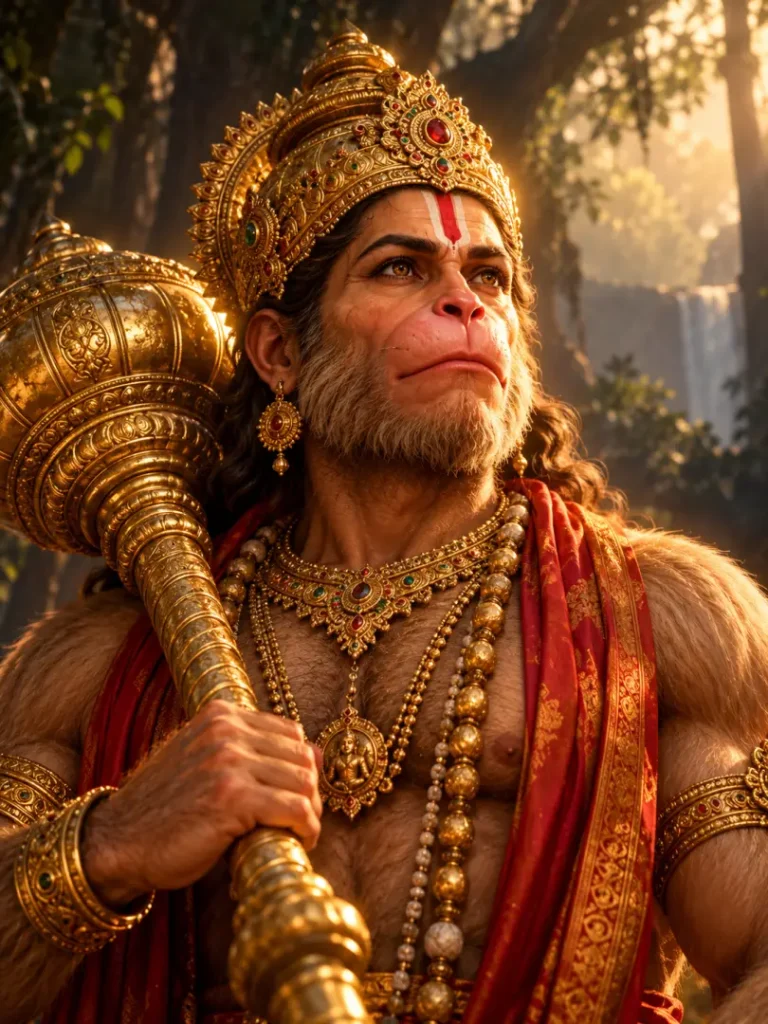
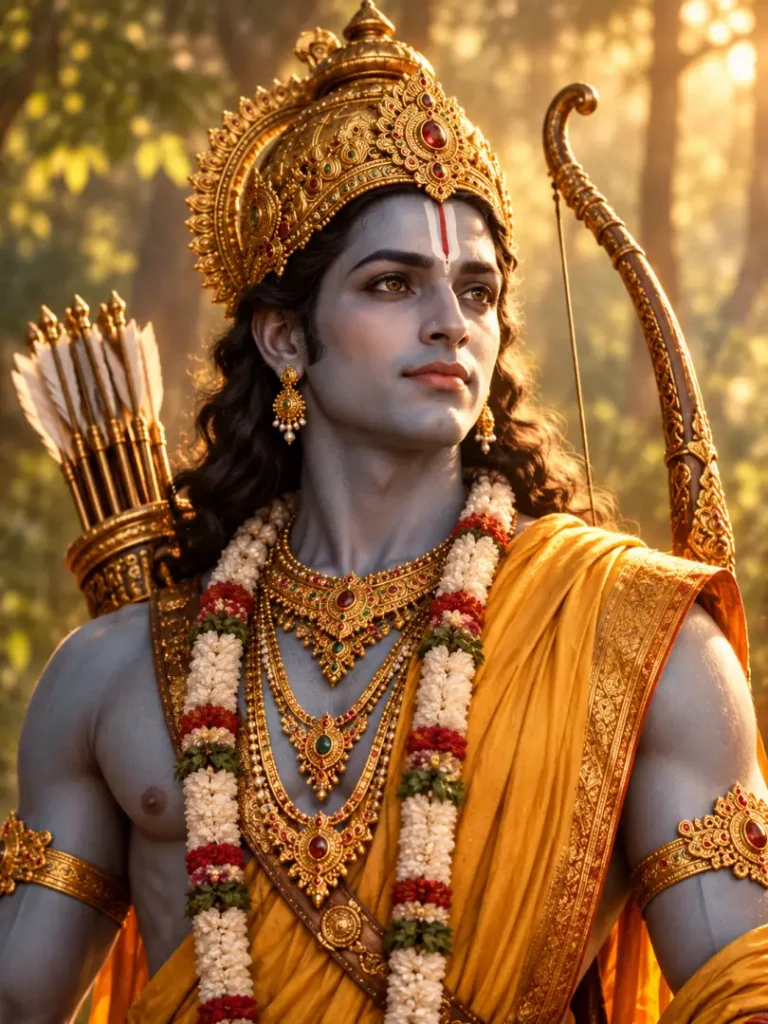
Who is in this story
The story
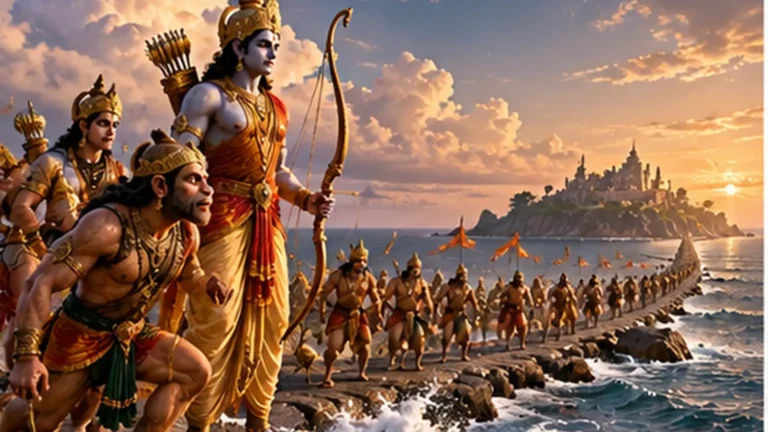
With the news that Sita was alive in Lanka, Rama marched south with Sugriva‘s vast army of vanaras and bears. They reached the shore of the southern ocean, and there the great sea lay between them and Lanka.
The refuge of Vibhishana
While they camped on the shore, Vibhishana, brother of Ravana, flew across from Lanka with four companions and asked for refuge. Many of the vanara leaders suspected him, but Rama declared that he would never refuse anyone who came to him for shelter, even Ravana himself, and he anointed Vibhishana king of Lanka there on the beach.
Rama and the Ocean
On Vibhishana’s advice Rama lay on a bed of kusha grass on the shore for three days and nights, praying to Samudra, the lord of the ocean, to let them pass. The ocean did not answer. Rama rose in anger, took up his bow, and began to shoot fiery arrows into the sea, which boiled and threw up its creatures in terror. Then Samudra rose from the waves with folded hands. He could not dry himself up, he said, for that would break the law of nature, but there was among the vanaras an architect, Nala, son of Vishwakarma, who could build a bridge, and the ocean would hold up whatever he built.
The building of the bridge
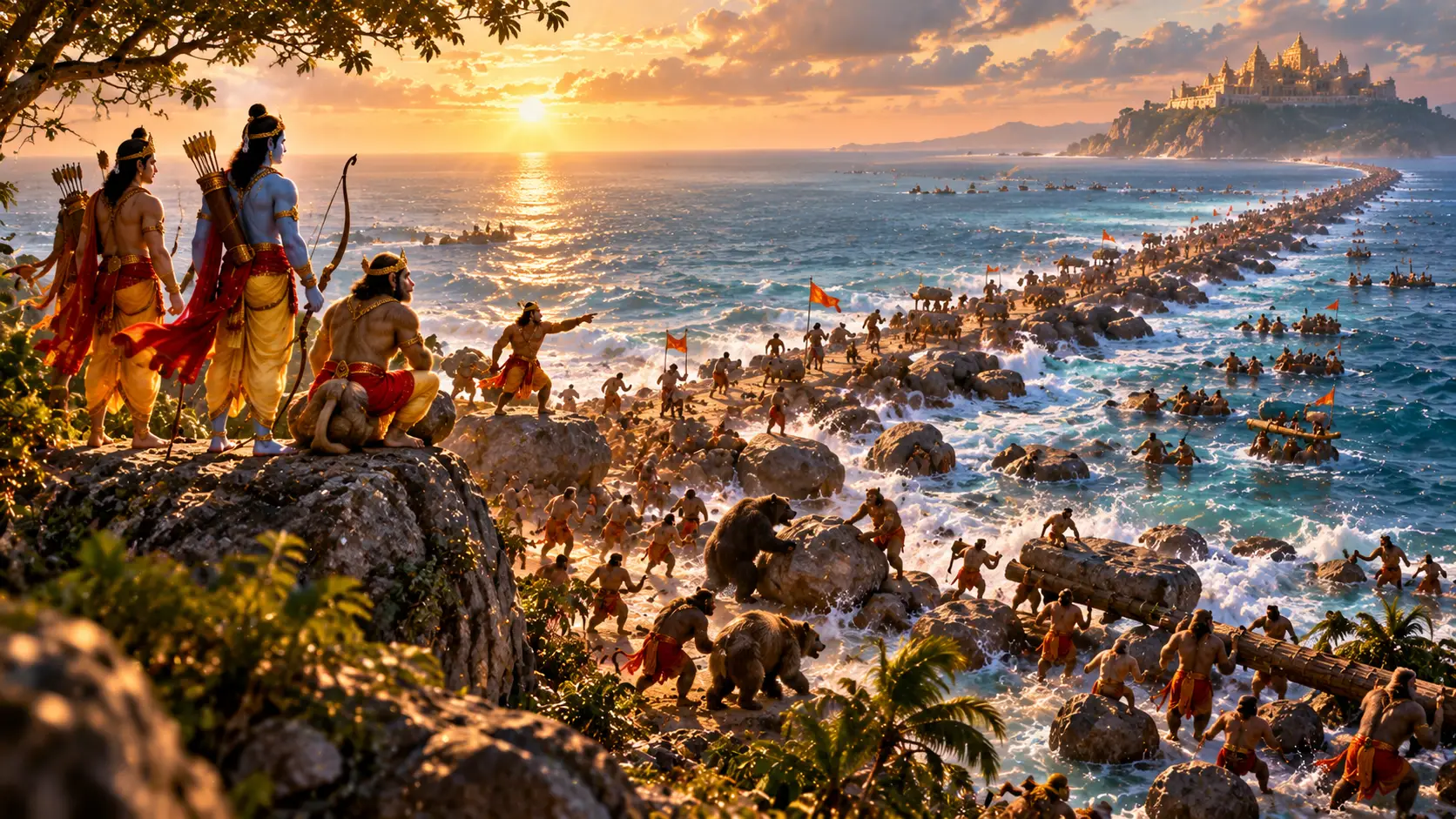
Nala and his companion Nila directed the work. The vanaras tore up trees and rocks from the hills, carried boulders the size of mountains, and threw them into the sea, where Nala set them in place. The Valmiki Ramayana counts the work day by day: fourteen yojanas on the first day, twenty on the second, twenty-one, twenty-two and twenty-three on the days that followed, until in five days the bridge, ten yojanas wide and a hundred long, stretched all the way to Lanka. The army crossed over, singing Rama’s name.
Stories that grew around the bridge
Later tradition added many loved details. In one, the stones floated because the name “Rama” was written on each one. In another, a small squirrel rolled in the sand and shook it off between the rocks to help, and Rama stroked its back, leaving the three stripes that squirrels carry to this day. These come from popular and regional retellings, not from Valmiki, but they are told in nearly every Indian home.
Rameswaram and Adam’s Bridge
The bridge is called Rama Setu or Nala Setu. A chain of limestone shoals between Pamban Island near Rameswaram in Tamil Nadu and Mannar Island in Sri Lanka, known in English as Adam’s Bridge, is traditionally identified with it. Tradition also says that before crossing, Rama worshipped Shiva at Rameswaram, where the Ramanathaswamy temple houses one of the twelve Jyotirlingas.
Meaning and lessons
The bridge is a story about many hands. Rama's divine power does not build it; the patient labour of countless vanaras, guided by a skilled architect, does. The squirrel's three stripes carry the same lesson: no offering made with love is too small. And Rama's refusal to turn Vibhishana away has made this book a pillar of the teaching on surrender, sharanagati.
Frequently asked questions
Who built the Rama Setu?
How long did it take to build the bridge?
Why did the stones float?
Is Adam's Bridge the Rama Setu?
Sources
- Valmiki Ramayana, Yuddha Kanda, sargas 17-22
- Kamba Ramayanam, Yuddha Kandam
- Tulsidas, Ramcharitmanas, Sundar and Lanka Kand
Read our editorial policy on how scripture, Purana and folk tradition are labelled.