Rameswaram
रामेश्वरमRameswaram, on Pamban Island in Tamil Nadu, is where tradition says Rama worshipped Shiva, using a lingam of sand shaped by Sita. Its Ramanathaswamy temple is one of the twelve Jyotirlingas and one of the Char Dham, with India's longest temple corridors and 22 sacred wells.
Why is Rameswaram sacred?
Rameswaram is a town on Pamban Island in the Ramanathapuram district of Tamil Nadu, at the tip of the Indian peninsula, facing Sri Lanka across the Palk Strait. It is one of the holiest places in India for both Vaishnavas and Shaivas: it is one of the Char Dham, the four abodes at the four corners of India (with Badrinath, Dwarka and Puri), and the Ramanathaswamy temple holds one of the twelve Jyotirlingas of Shiva.
The legend of the lingam
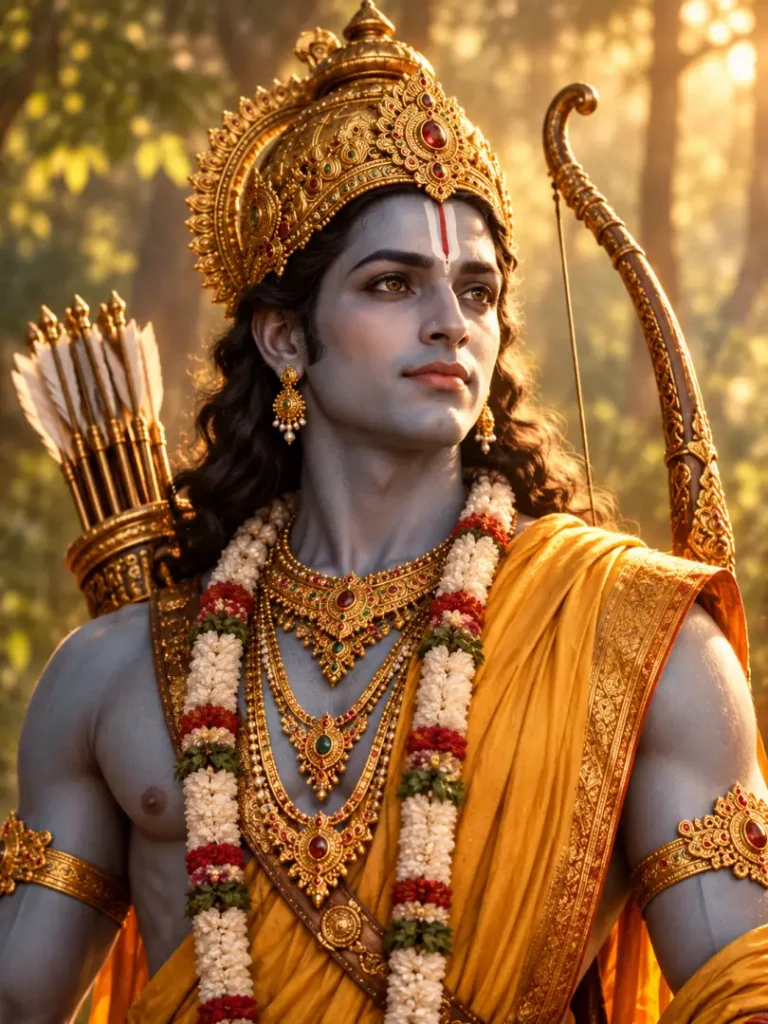
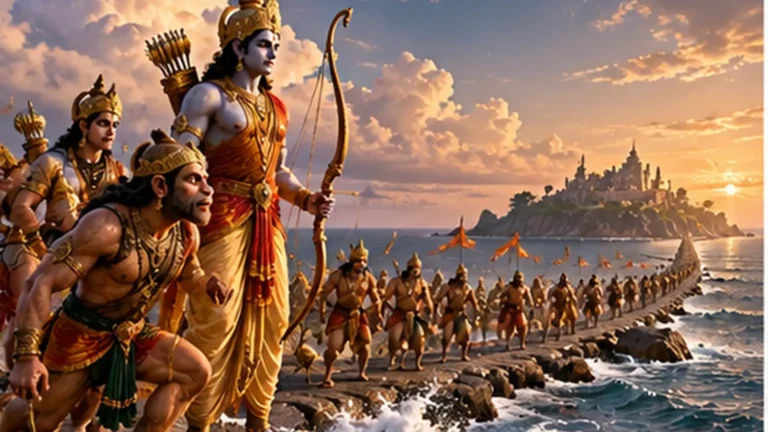
The name means “the lord of Rama”. Two stories are told. In the first, Rama, before building the bridge to Lanka, worshipped Shiva here to ask for victory. In the more widely told version, after killing Ravana, who was a Brahmin by birth, Rama wished to atone and decided to worship Shiva. He sent Hanuman to Mount Kailash to bring a lingam. When Hanuman was delayed and the auspicious moment drew near, Sita shaped a lingam out of sand, the Ramalingam, and Rama worshipped it. When Hanuman returned with his lingam from the Himalayas, the Vishwalingam, he was dismayed; Rama consoled him by installing it beside the first and ordering that it be worshipped first. That order is still followed in the temple today.
The Ramanathaswamy temple
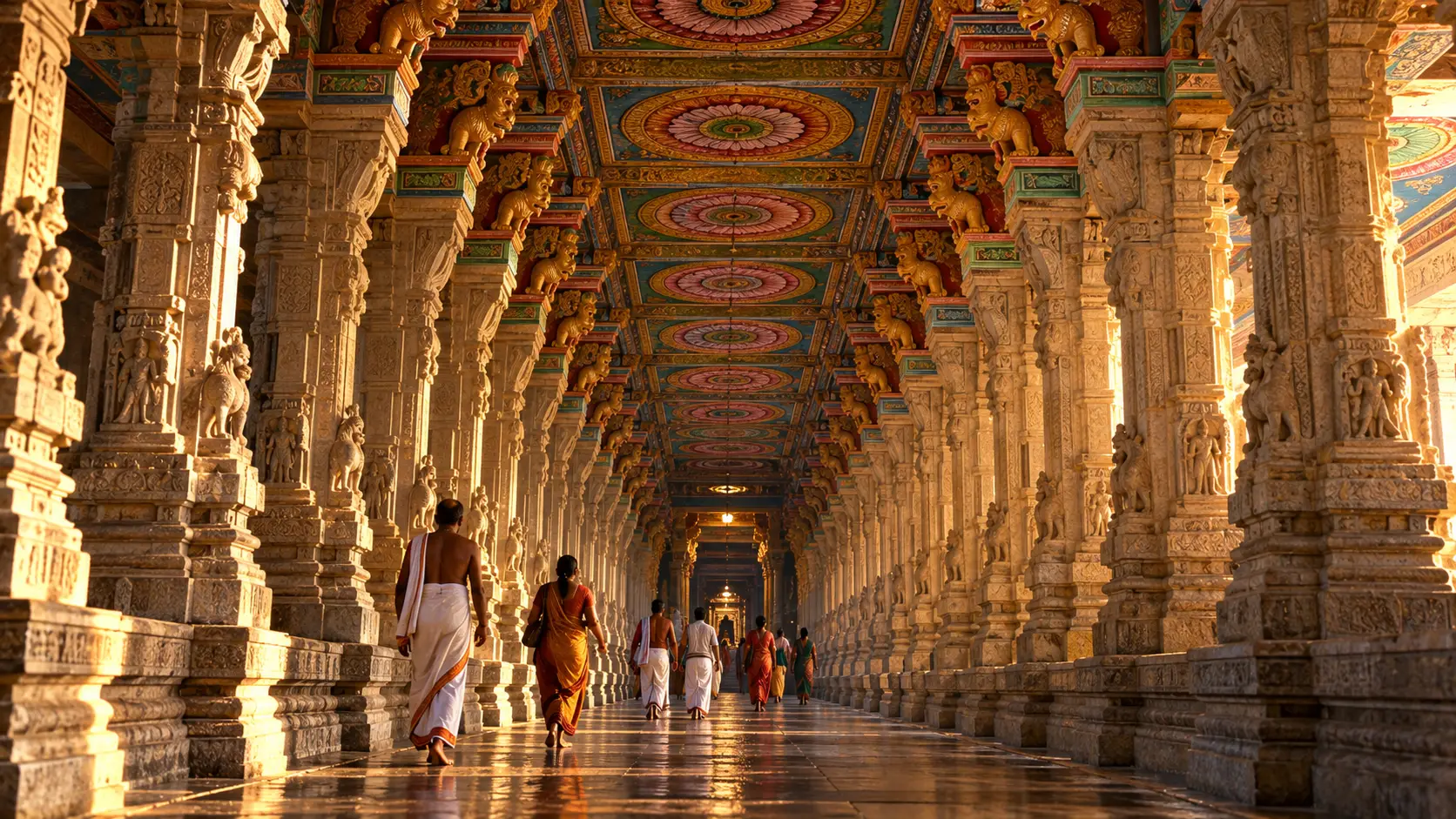
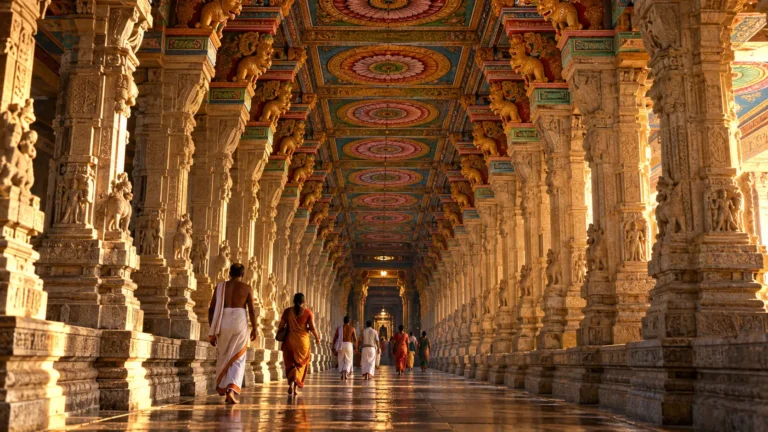
The temple, built and enlarged by the Pandya and later the Sethupathi rulers of Ramanathapuram from the 12th century onward, is famous for having the longest temple corridors in India: its outer corridor runs about 1,220 metres, lined with nearly 1,200 carved pillars. Inside the temple complex are 22 sacred wells, the theerthams, and pilgrims bathe in water drawn from each in turn before darshan. They first bathe in the sea at Agni Theertham, just outside the east gate.
Around Rameswaram
- Dhanushkodi – the abandoned town at the end of the island, destroyed by a cyclone in 1964, where tradition says Rama marked the place of the bridge with the end of his bow (dhanush).
- Rama Setu – the chain of shoals running from here to Mannar Island, traditionally identified with the bridge built by the vanaras.
- Gandhamadhana Parvatham – a small hill with a shrine holding an imprint said to be Rama’s footprints.
- Kothandaramaswamy Temple – said to stand where Vibhishana surrendered to Rama.
- Panchamukhi Hanuman Temple – known for its floating stones, said to be like those used for the bridge.
The Kashi-Rameswaram pilgrimage
An old custom joins Rameswaram to Varanasi. Pilgrims take sand from the sea at Rameswaram to immerse in the Ganga at Kashi, and bring back Ganga water to pour over the lingam at Rameswaram, completing the pilgrimage.
How to reach Rameswaram
Rameswaram is linked to the mainland by the Pamban road bridge and the new Pamban rail bridge, opened in 2025. Trains run from Chennai and Madurai; the nearest airport is Madurai, about 170 km away.
Significance and legend
Rameswaram unites the worship of Vishnu and Shiva: it is the place where Rama, an avatar of Vishnu, worshipped Shiva, and Shiva is worshipped as the lord of Rama. A pilgrimage to India's sacred places is traditionally considered incomplete without visiting both Kashi and Rameswaram.