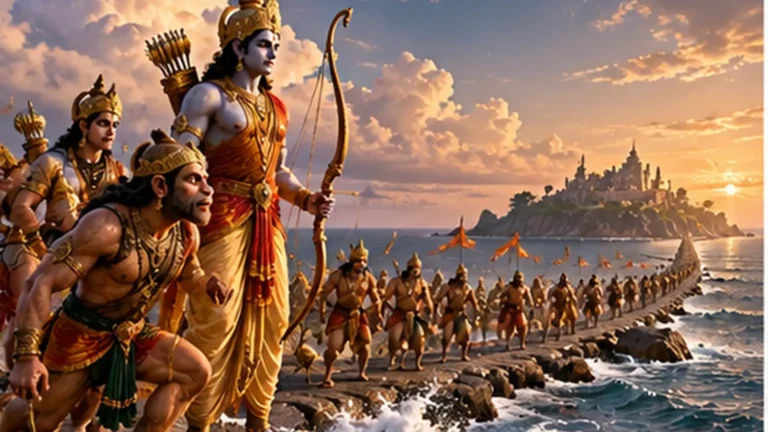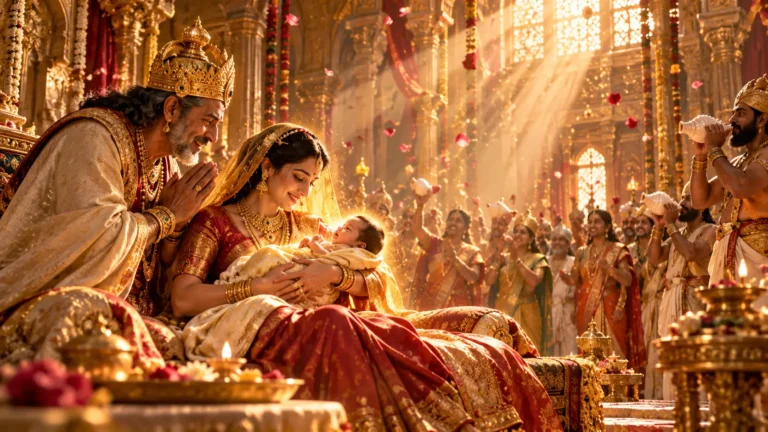
Who is in this story
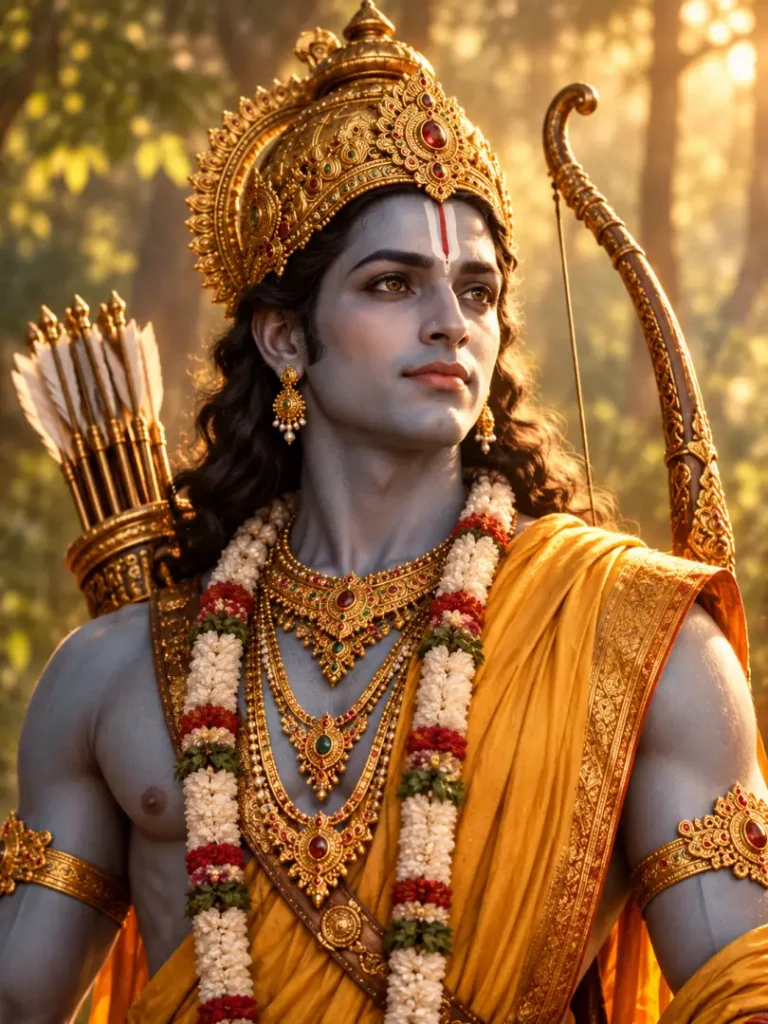

The story
When the sage Vishwamitra’s sacrifice had been completed under the protection of the young princes Rama and Lakshmana, he told them that King Janaka of Mithila was about to hold a great sacrifice of his own, and that in Janaka’s palace there was a bow no man could lift. The three set out north and east along the Ganga.
The road to Mithila
On the way they passed an empty hermitage, silent and overgrown. Vishwamitra explained that it had belonged to the sage Gautama, whose wife Ahalya had been cursed for her part in Indra’s deception and had stood there for ages, unseen by any living being. As Rama entered, Ahalya was freed from the curse and stood before them, shining like a flame through smoke, and she welcomed the princes as honoured guests. Then they went on to Mithila, where Janaka received them with joy.
The bow of Shiva
Janaka told the story of the bow. It had belonged to Shiva himself, who had raised it in fury against the gods at the sacrifice of Daksha, and later gave it to them. The gods left it with Devarata, an ancestor of Janaka, and it had passed down the line ever since. Janaka also told how, ploughing a field for a sacrifice, he had found a baby girl in the furrow, and raised her as his own daughter: Sita. He had vowed that only a man who could string Shiva’s bow would marry her. Kings and princes had come from every land; not one could even lift it, and some had made war on Mithila in their shame.
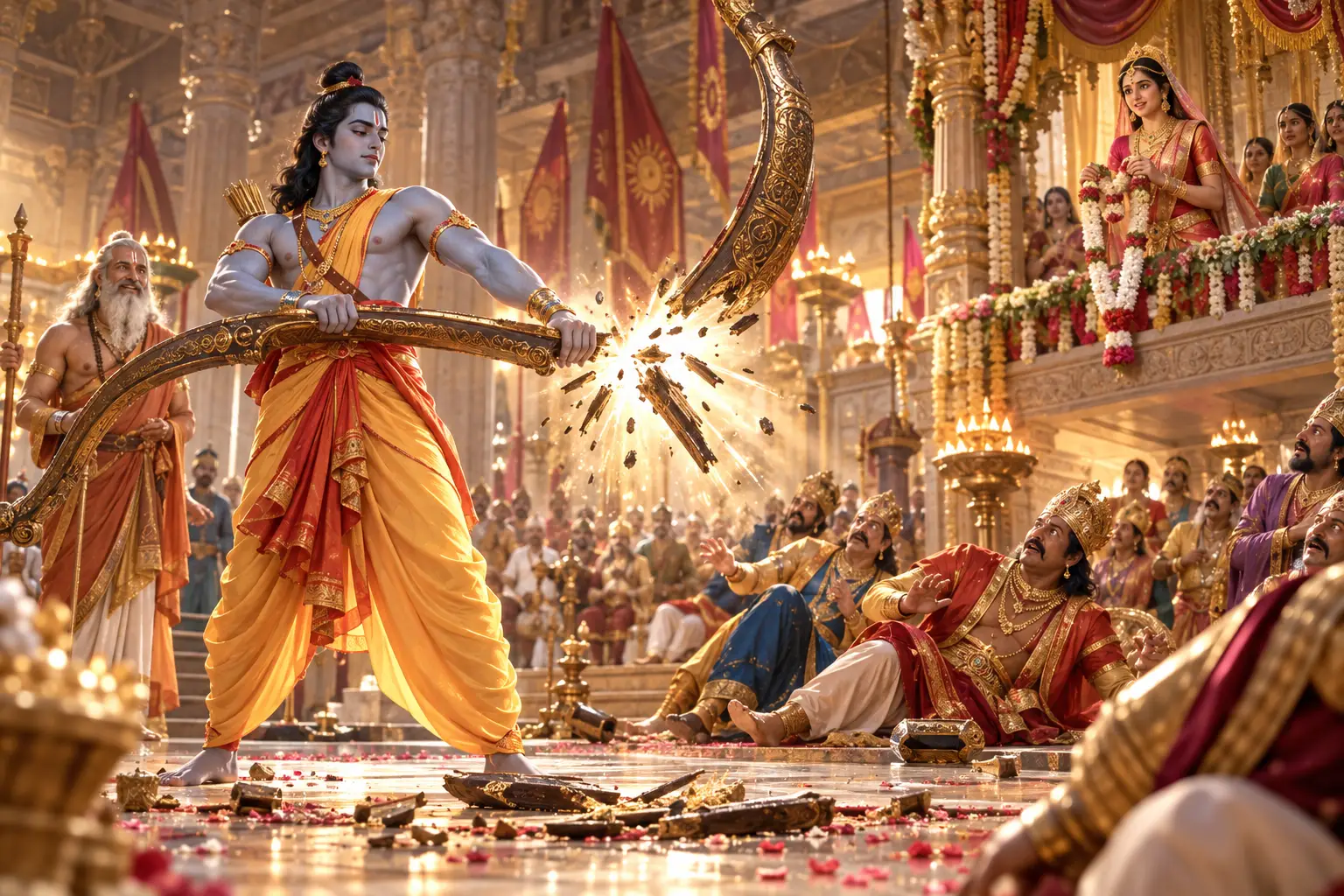
At Vishwamitra’s request the bow was brought out. It lay in an iron chest on an eight-wheeled cart, and it took five thousand strong men to draw it into the hall. Rama, with the sage’s blessing, lifted the bow as if it were a toy. He set one end against the ground, bent it and drew the string to his ear, and with a sound like a thunderclap, the great bow snapped in two. The crowd fell to the ground in astonishment; only Janaka, Vishwamitra and the two princes stayed on their feet.
Four weddings
Janaka gave Sita to Rama. Messengers raced to Ayodhya, and King Dasharatha came with his court. Janaka’s other daughter Urmila was married to Lakshmana, and his brother Kushadhvaja’s daughters Mandavi and Shrutakirti to Bharata and Shatrughna, so that four brothers married four sisters on the same day. The wedding of Rama and Sita is still celebrated each year as Vivah Panchami, above all at Janakpur in Nepal.
Parashurama’s challenge
On the road home, the sky darkened and the warrior-sage Parashurama appeared, axe on his shoulder, enraged that the bow of Shiva, his teacher, had been broken. He held out a second bow, the bow of Vishnu, Sharanga, and challenged Rama to string it. Rama took it, strung it in a moment, and fitted an arrow. Parashurama, seeing Vishnu in the young prince, surrendered the merit of his austerities to that arrow and went back to his mountain. The party returned to Ayodhya in triumph.
Meaning and lessons
The story shows strength that comes with humility: Rama lifts the bow only when his teacher asks, and without boasting. Ahalya's release on the way to Mithila tells devotees that grace can free anyone, however long they have waited. And Parashurama's surrender marks a turning point: the age of the angry warrior gives way to the age of the righteous king.
Festivals that celebrate this story
Frequently asked questions
Which bow did Rama break?
Why did Rama break the bow?
Who challenged Rama after he broke the bow?
Sources
- Valmiki Ramayana, Bala Kanda, sargas 48-49 (Ahalya), 65-73 (the bow and the weddings), 74-77 (Parashurama)
- Tulsidas, Ramcharitmanas, Bal Kand
Read our editorial policy on how scripture, Purana and folk tradition are labelled.