Saraswati
सरस्वतीGoddess of knowledge, speech, music and the arts. Also called Sharada, Vagdevi, Bharati, Vidyadayini, Veenapani, Savitri, Gayatri.
Saraswati is the goddess of knowledge, speech, music and the arts, and the consort of Brahma. Praised in the Rigveda as the greatest of rivers, she is shown in white with a veena, a book and a swan. Students and artists worship her above all on Vasant Panchami.
Who is Saraswati?
Saraswati (सरस्वती) is the goddess of knowledge, learning, speech, music and the arts, and the consort of Brahma, the creator. Dressed in white, seated on a white lotus or a swan, with the veena in her hands, she is worshipped by students, scholars, musicians and artists across India and beyond. With Lakshmi and Parvati she forms the Tridevi, the three great goddesses.
From river to goddess
Saraswati is first a river. The Rigveda praises the Sarasvati as the greatest of rivers, flowing from the mountains to the sea, and in hymn 2.41.16 calls her “best of mothers, best of rivers, best of goddesses”. The river was also linked with Vac, sacred speech, because the Vedic hymns were sung on her banks. As the physical river faded, the goddess of speech and knowledge remained. Tradition still holds that an unseen Saraswati joins the Ganga and Yamuna at the Triveni Sangam at Prayagraj.
Saraswati and Brahma
The Puranas describe Saraswati as the power, or shakti, of Brahma: knowledge is what makes creation possible. In some accounts she is born from Brahma himself, in others from the Goddess. She is also called Savitri, Gayatri, Vagdevi (goddess of speech), Sharada, Bharati and Vidyadayini (giver of knowledge). A story in the Padma Purana tells that when Brahma performed a sacrifice at Pushkar and his wife Savitri was late, he married Gayatri to complete the rite, and Savitri cursed that Brahma would be worshipped only at Pushkar.
What does Saraswati look like?
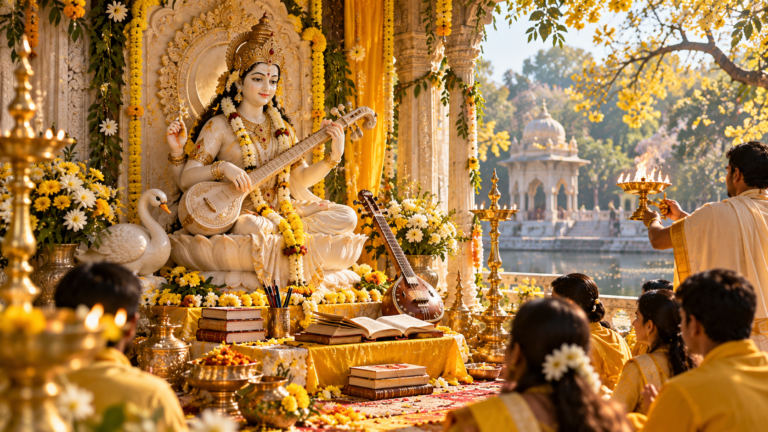
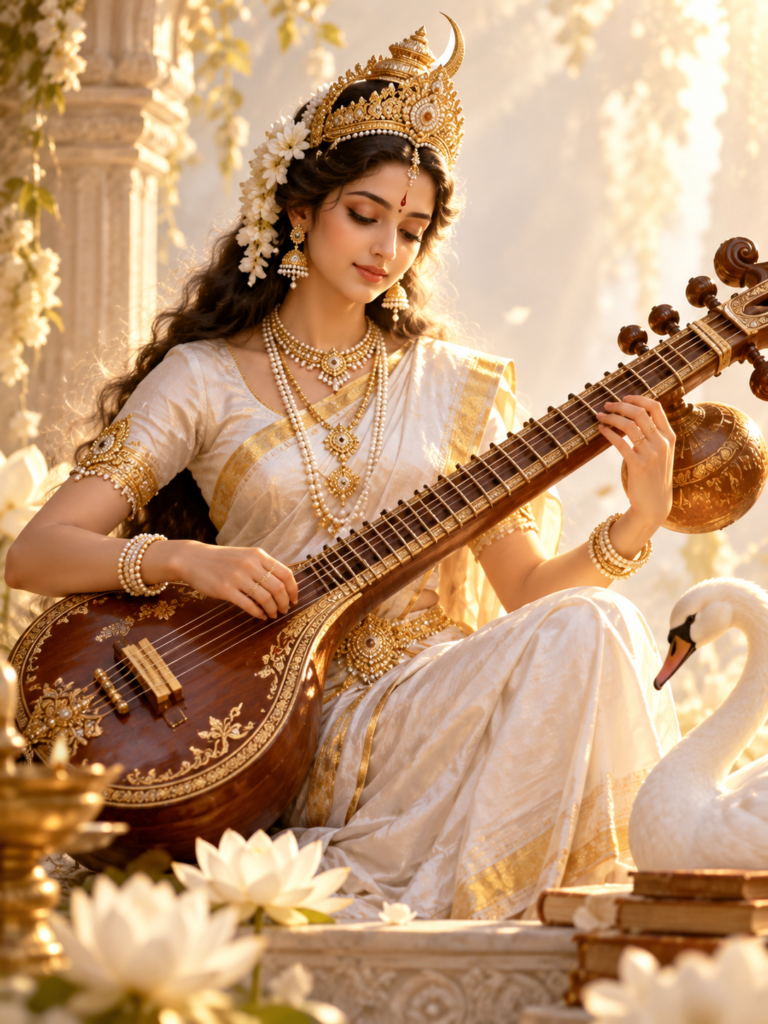
She is shown fair and serene, in a white sari, with four arms holding the veena (music and the arts), a book (the Vedas and all learning), a rosary (meditation) and a water pot (purity). Her mount is the white swan, the hamsa, which is said to separate milk from water, the image of discernment; sometimes a peacock sits beside her. White is her colour: the colour of pure knowledge.
How is Saraswati worshipped?
- Vasant Panchami, in Magha (January to February), is her great festival. Children are introduced to letters, people wear yellow, and books, pens and instruments are placed before her for blessing. In Bengal, Odisha and Assam it is celebrated as Saraswati Puja.
- In Navratri, especially in South India, the last days are dedicated to her: books and tools are worshipped on Ayudha Puja, and on Vijayadashami children begin learning in the ceremony of Vidyarambham.
- Her shrines include the Sharada temple at Sringeri, the Gnana Saraswati temple at Basar in Telangana, and the ancient Sharada Peeth in Kashmir.
- She is honoured in Buddhism and Jainism too, and in Japan as Benzaiten, goddess of music and eloquence.