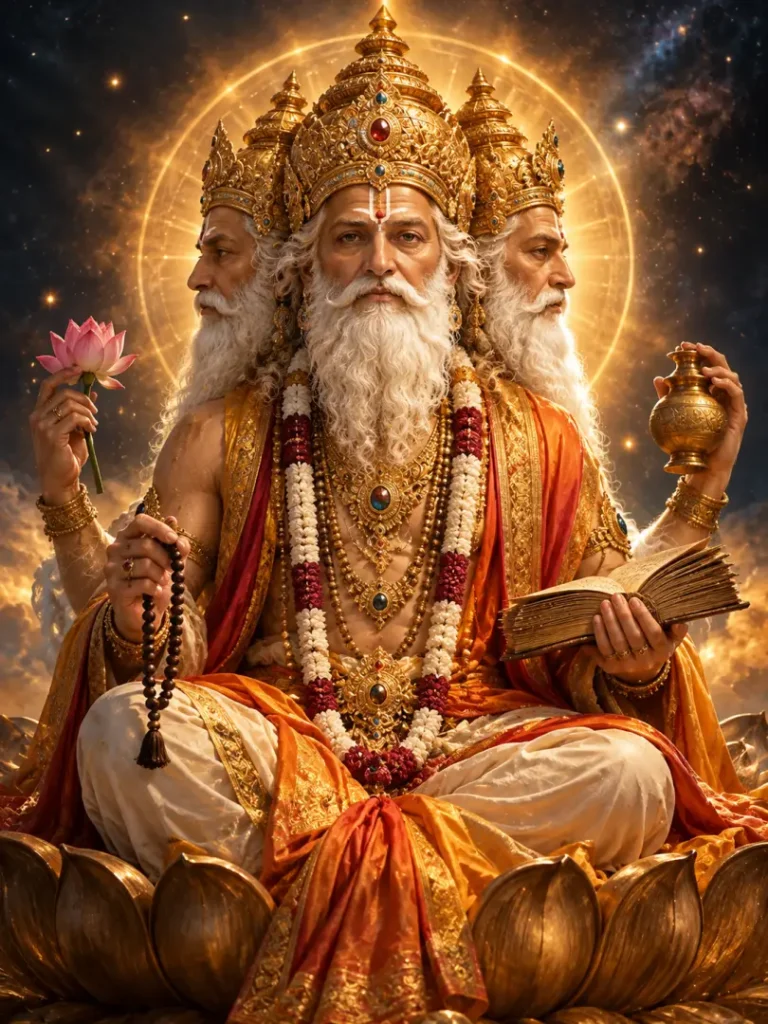

Hamsa
हंसThe hamsa is the divine swan or goose that carries Brahma and Saraswati. Tradition says it can separate milk from water, so it stands for discernment between the real and the unreal. Brahma flies as a hamsa in the story of the pillar of light, and the highest renunciants are called paramahamsa.
What is the Hamsa?
The hamsa is a white swan or wild goose that serves as the vahana, or mount, of Brahma, and also carries his consort Saraswati. In sculpture it appears at Brahma's feet or bears him and Saraswati through the sky.
The bird has been sacred since Vedic times, when it was linked with the Sun and the breath.
The swan in the stories
- The pillar of light — In the Shiva Purana’s story of the Lingodbhava, Brahma takes the form of a hamsa and flies upward to find the top of the endless pillar of fire, while Vishnu as a boar digs down to find its base.
- Hamsa as Vishnu — The Bhagavata Purana (Book 11, ch. 13) tells how Vishnu appeared as a swan to answer the questions of the four Kumaras about the mind and liberation, and the Mahabharata counts Hamsa among his forms.
- Nala and Damayanti — In the Mahabharata’s tale of Nala, a golden swan carries word of Nala’s virtues to the princess Damayanti and so brings the two lovers together.
Paramahamsa
Because the hamsa is the bird of discernment that flies high above the world, the highest class of renunciants is called paramahamsa, the supreme swan, a title borne by teachers such as Ramakrishna Paramahamsa. Yogic texts also hear the breath as ham-sa, the natural mantra repeated with every breath in and out.
What does it symbolise?
The hamsa is famous for nira-kshira viveka: the power to separate milk from water and drink only the milk. Tradition reads this as discrimination between the eternal and the passing, the real and the unreal, which is the gift of knowledge. Because it moves easily…