Quick answer
Shurpanakha story from the Valmiki Ramayana: Ravana's widowed sister, her meeting with Rama and Lakshmana at Panchavati, her wound, and how she set the war with Lanka in motion.
Who is in this story

The story
Shurpanakha, Ravana’s sister, sets the Ramayana’s war in motion. Her meeting with Rama and Lakshmana in the forest, and the wound she received there, led straight to the abduction of Sita. Popular retellings often reduce her to a villain or a figure of mockery, but the Valmiki Ramayana and later traditions give her a fuller story. This guide tells the Shurpanakha story in order and separates what Valmiki says from later interpretation.
Shurpanakha story: who she was
Shurpanakha was the daughter of the sage Vishrava and the rakshasa princess Kaikasi, and the sister of Ravana, Kumbhakarna and Vibhishana. Her name is usually explained as “one with nails like winnowing baskets”. The Uttara Kanda says she married the rakshasa Vidyujjihva, and that Ravana killed him during one of his campaigns of conquest. Ravana then sent his widowed sister to live in the Dandaka forest under the protection of their kinsmen Khara and Dushana.
Meeting Rama at Panchavati
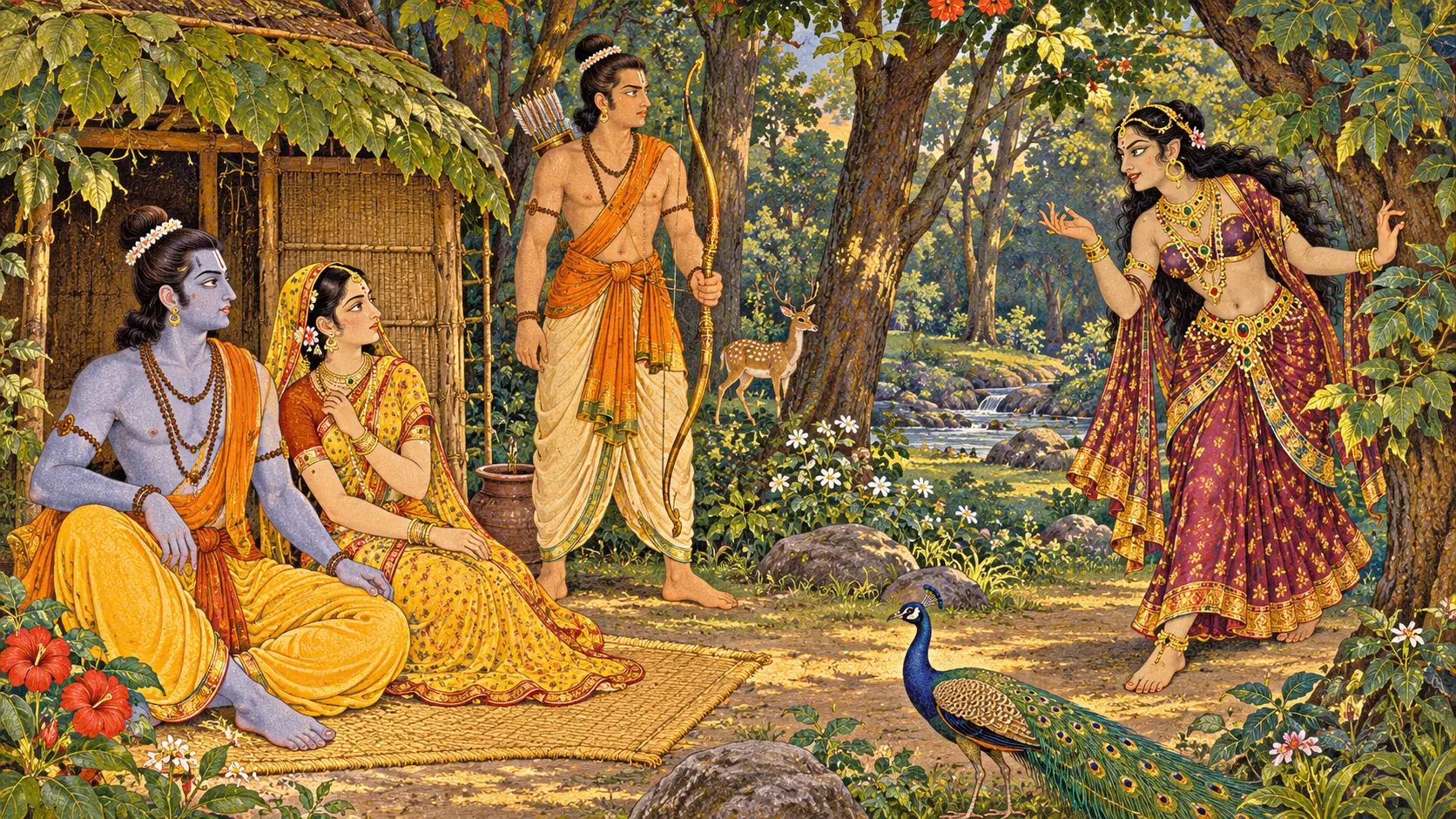
In the Aranya Kanda, Shurpanakha sees Rama at his hermitage in Panchavati and is drawn to him at once. She approaches and proposes marriage. Rama replies that he is already married to Sita and jokingly suggests she try his brother. Lakshmana in turn sends her back to Rama, and the exchange becomes a cruel game.
The wound and its consequences
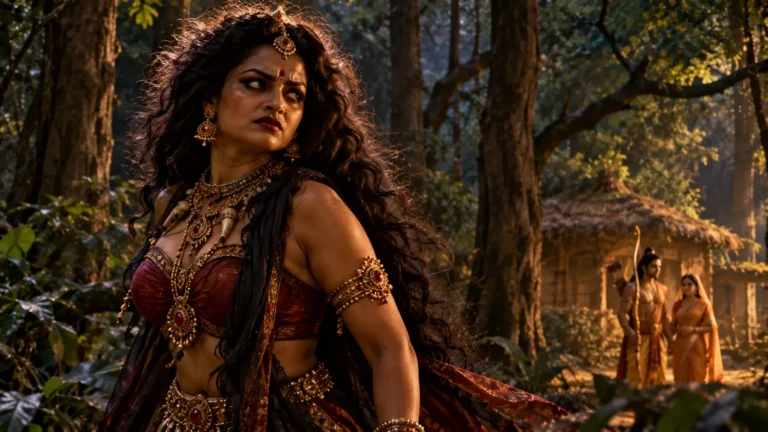
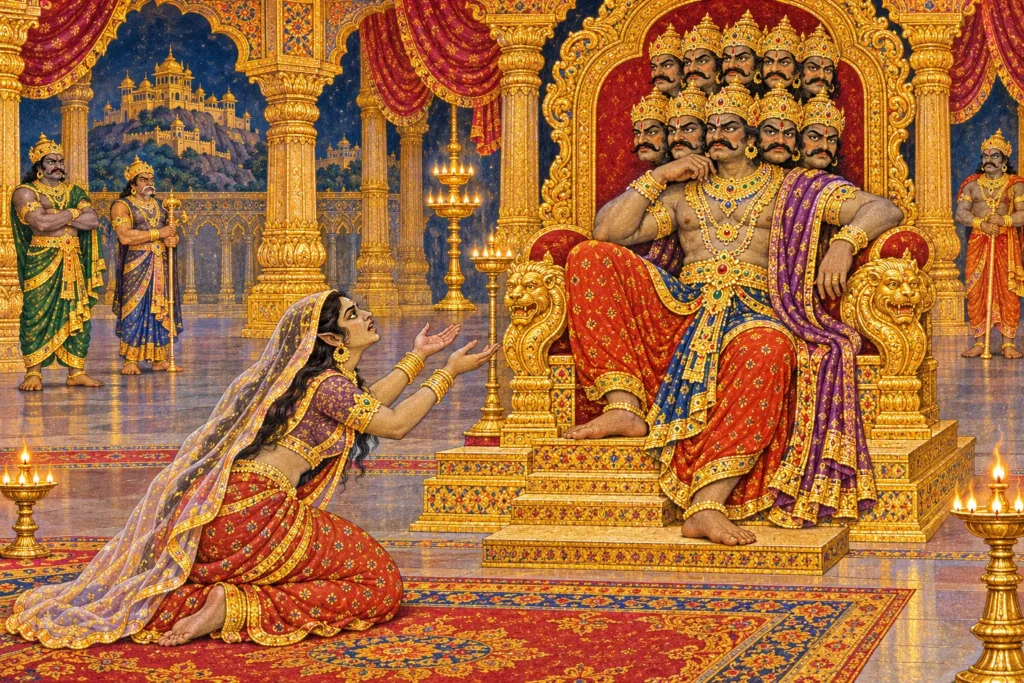
Humiliated and angry, Shurpanakha rushes at Sita, believing her to be the obstacle. Rama tells Lakshmana to stop her, and Lakshmana cuts off her nose and ears. She flees to Khara, who sends fourteen rakshasas and then marches with Dushana and a large army, all of whom Rama destroys. Shurpanakha then goes to Ravana in Lanka, tells him of the brothers and describes Sita’s beauty, urging him to take her. This is the spark that leads to the golden deer and the abduction.
Was she seeking revenge?
Some later tellings and modern readers suggest that Shurpanakha secretly wanted to destroy Ravana, the brother who had killed her husband, and that sending him after Sita was her way of bringing him down. Valmiki does not say this. It is an interpretation that has grown popular because the epic itself records that Ravana killed her husband.
How readers see her today
Traditional readings treat Shurpanakha as the cause of the war and a lesson about uncontrolled desire. Many modern readers also question the brothers’ mockery and the violence of her punishment, and some retellings tell the story from her side. The epic leaves room for both readings: her actions start a chain of events, but she is also a wronged widow and a woman humiliated.
Why the Shurpanakha story matters
Without Shurpanakha there is no abduction, no war and no return to Ayodhya. Her story shows how a single encounter, driven by desire, pride and anger on more than one side, can change the fate of kingdoms. For the wider cast, read Ramayana characters explained, and read the Aranya Kanda in the Valmiki Ramayana.
Frequently asked questions
Who was Shurpanakha?
Shurpanakha was Ravana’s sister, the daughter of Vishrava and Kaikasi, and the widow of the rakshasa Vidyujjihva.
Why did Lakshmana cut Shurpanakha's nose?
After she attacked Sita, Rama told Lakshmana to stop her, and Lakshmana cut off her nose and ears, as told in the Aranya Kanda.
Did Shurpanakha want revenge on Ravana?
Valmiki does not say so. The revenge theory, based on Ravana having killed her husband, is a later interpretation.
Sources and further reading
Read our editorial policy on how scripture, Purana and folk tradition are labelled.