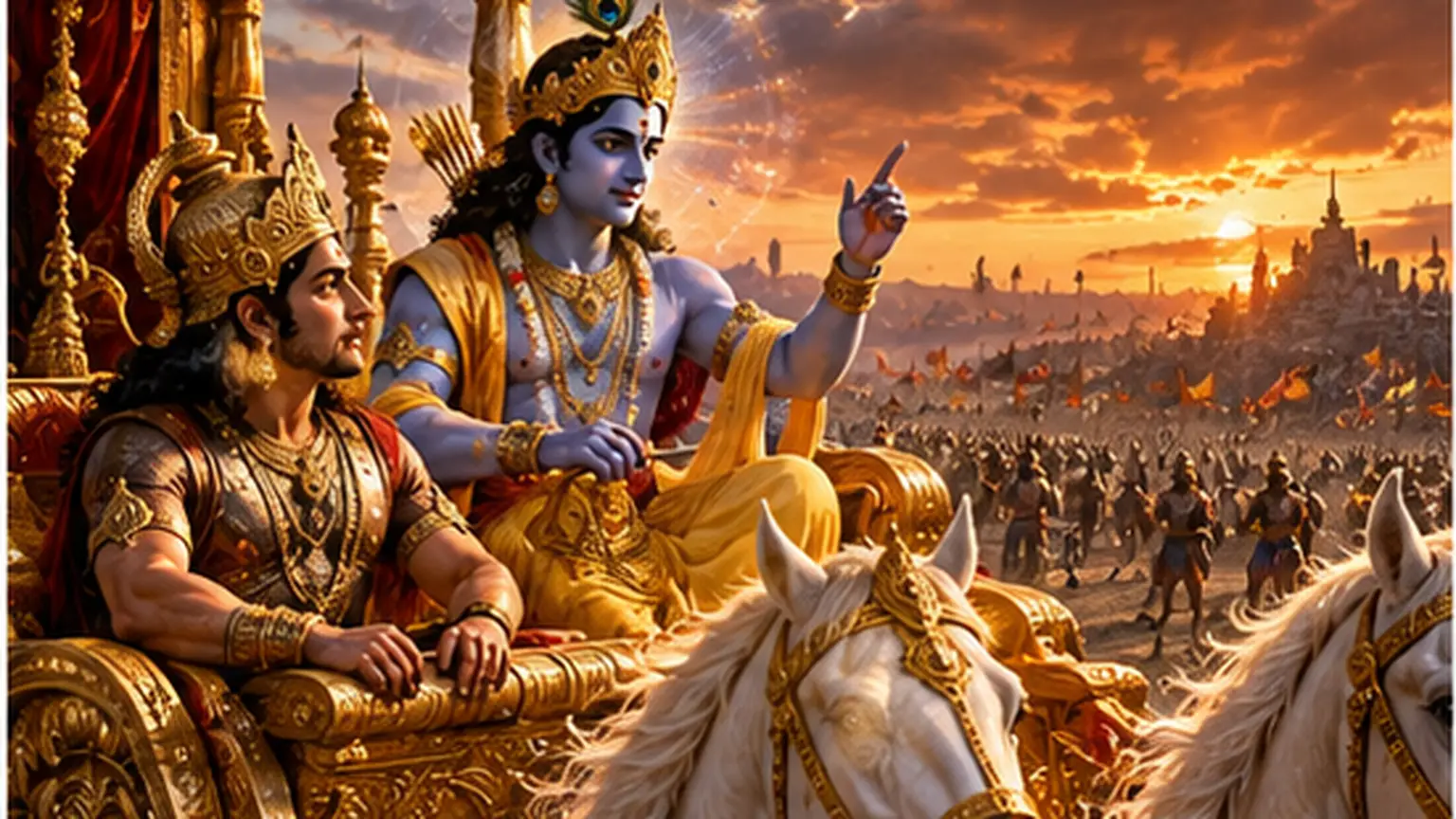
The Mahabharata, in full
The Mahabharata is the longest epic poem in the world, telling of the dynastic struggle between the Pandavas and the Kauravas that culminates in the great war at Kurukshetra. Traditionally attributed to the sage Vyasa, it is at once a gripping story and a vast storehouse of philosophy, law and myth, and within it lies the Bhagavad Gita.
The story in brief
The throne of Hastinapura is disputed between two sets of cousins: the five Pandava brothers, led by the righteous Yudhishthira and including the great archer Arjuna, and the hundred Kaurava brothers, led by Duryodhana. After the Pandavas lose their kingdom, their wife Draupadi, and themselves in a rigged game of dice and endure thirteen years of exile, the refusal to restore their lands leads to the eighteen-day war at Kurukshetra, in which nearly all the warriors of the age perish, including Karna. Krishna, Arjuna’s charioteer and guide, is the hinge of the whole epic.
A treasury within a story
Around its central narrative the Mahabharata gathers a vast body of teaching: the Bhagavad Gita, the Vishnu Sahasranama, the stories of Nala and Damayanti and of Savitri and Satyavan, the Yaksha Prashna, and long discourses on dharma, karma and liberation. It is said of the epic that “what is not here is nowhere else”.
Authorship and scale
Tradition holds that Vyasa composed it and the elephant-headed Ganesha wrote it down. In about 100,000 verses across eighteen parvas (books), it is roughly ten times the length of the Iliad and the Odyssey combined. Historians date its composition in stages between roughly the 4th century BCE and the 4th century CE.