The story
Every telling of the Ramayana begins with a longing: the great king Dasharatha of Ayodhya, lord of the solar Ikshvaku line, had everything a king could wish for except the one thing he wanted most, a son to continue his house. The birth of Rama and his brothers is the answer to that longing, and it is also the moment the divine chose to enter the world.
The sorrow of a childless king
Dasharatha had ruled long and well, with three noble queens, Kausalya, Kaikeyi and Sumitra, yet no child had been born to any of them. As age came upon him, the fear of leaving the throne of the Raghus without an heir weighed on him more than any enemy. At last, on the counsel of his family guru Vasishtha, he resolved to perform the greatest of rites to obtain sons: first the Ashvamedha, the horse sacrifice, and then the Putrakameshti, the sacrifice performed to gain children.
The sage who came to help
To conduct the Putrakameshti the sages chose Rishyasringa, a young ascetic of such innocence and power that rain itself was said to follow wherever he went. Rishyasringa, whose own son would one day be the rakshasa Alambusha, came to Ayodhya, kindled the sacred fire with the proper mantras, and summoned the gods to receive their share of the offering.
The bowl of divine payasam
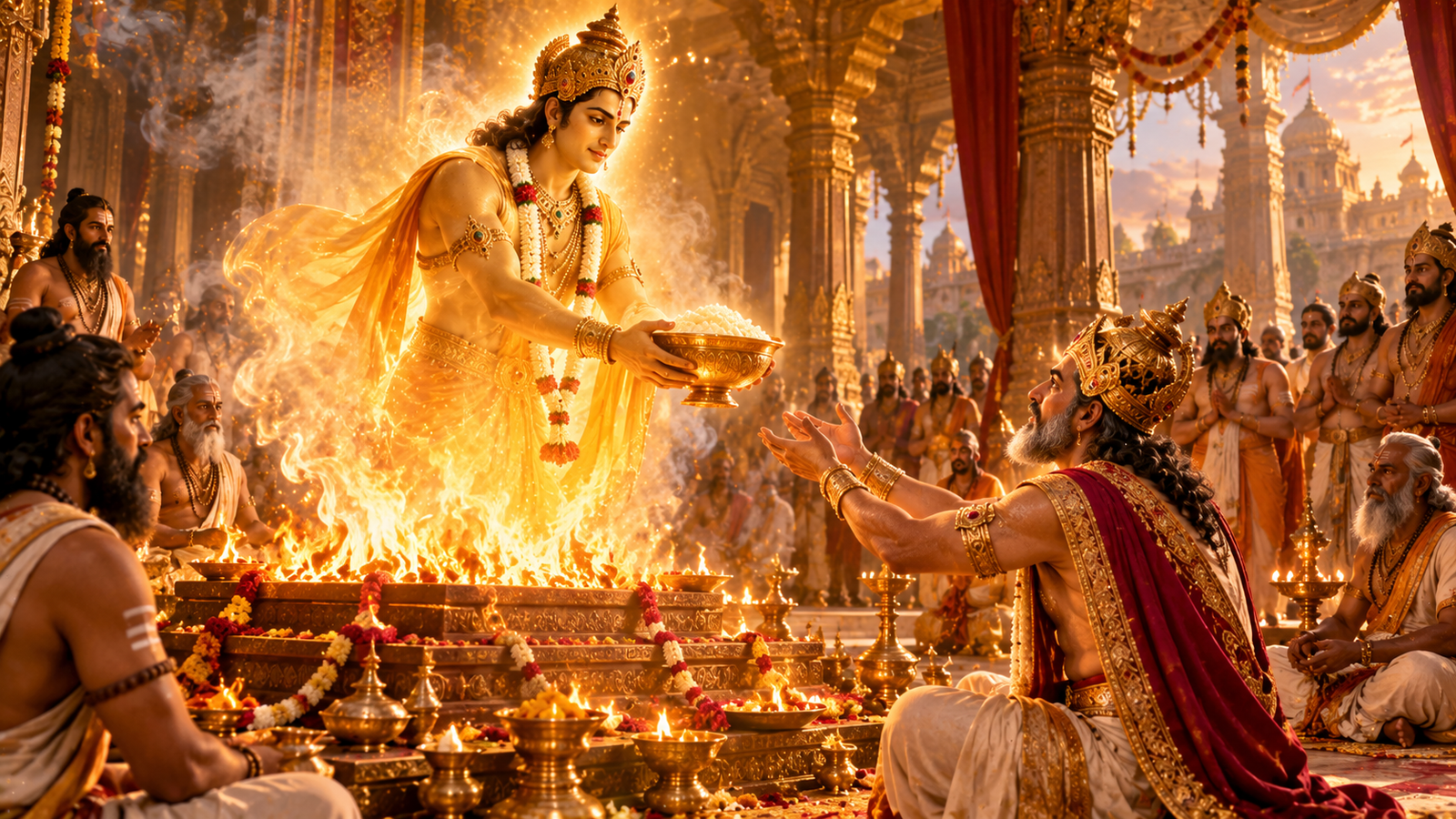
As the fire blazed, a radiant being rose from the flames, tall and glowing, bearing in his hands a golden vessel filled with divine payasam, sweet rice blessed by the gods. “Take this,” he said to Dasharatha, “and give it to your queens, and they shall bear you sons.” The joyful king gave half of the payasam to Kausalya and a share to Kaikeyi, and divided the remainder once more for Sumitra, so that she received two portions.
The descent of Vishnu
At that very time, in the heavens, the gods were in despair. The rakshasa king Ravana had grown unconquerable through a boon that no god or demon could slay him, and he tormented the three worlds. They went to Vishnu and begged him to be born as a man, for Ravana in his pride had not thought to seek protection from mortals. Vishnu agreed, and chose to be born as the sons of Dasharatha, pouring his divine presence most fully into the eldest.
The birth of the four princes
In due time the queens conceived, and on the ninth day of the bright half of the month of Chaitra, under an auspicious conjunction of stars, Kausalya gave birth to Rama, dark as a rain-cloud and bearing the marks of Vishnu. Kaikeyi bore Bharata, and Sumitra, who had taken two portions, bore the twins Lakshmana and Shatrughna. Ayodhya overflowed with joy, and that day has been celebrated ever since as Rama Navami.
The meaning of the story
The birth of Rama joins two longings into one: a father’s prayer for a child, and the prayer of the whole world for deliverance from evil. It teaches that the divine does not descend by its own whim alone but in answer to sincere devotion and need, and that the greatest events often begin in the quiet grief of a single human heart.
Meaning and lessons
The story joins a father's prayer for a child with the world's prayer for rescue from evil, teaching that the divine descends in answer to sincere need, and that the greatest events may begin in the quiet grief of one human heart.
Frequently asked questions
Why was Dasharatha childless for so long?
What is the Putrakameshti yagna?
Who performed the sacrifice for Dasharatha?
When was Rama born?
Who were Rama's brothers and their mothers?
Why did Vishnu choose to be born as Rama?
Sources
- Valmiki Ramayana, Bala Kanda (sargas 8-18)
- Ramcharitmanas of Tulsidas, Bala Kanda
- Wikipedia, "Rama" (accessed Oct 2026)
Read our editorial policy on how scripture, Purana and folk tradition are labelled.