Kali
कालीGoddess of time, death, the destruction of evil and final liberation; the fierce Mother. Also called Mahakali, Shyama, Kalika, Chamunda, Bhadrakali, Dakshina Kali, Adya.
Kali is the fierce dark goddess of time, death and liberation, a form of the great Goddess and the first of the ten Mahavidyas of Tantra. Born from Durga's wrath to slay the demon Raktabija, she is depicted blue-black, garlanded with severed heads and dancing on Shiva. Though terrifying, she is adored as the tender Mother, worshipped at Kali Puja and at Kalighat and Dakshineswar.
Who is Kali?
Kali (Sanskrit: काली, Kālī) is the fierce and liberating goddess of Hinduism, the dark Mother who is Time itself, the destroyer of evil and of the ego, and the giver of final freedom. She is at once the most terrifying and the most tender of deities: black as the void before creation, garlanded with severed heads and dancing upon the body of Shiva, yet worshipped by her devotees simply as Ma, the Mother who hides nothing and fears nothing. She is a form of the great Goddess, Mahadevi, and is counted the first of the ten Mahavidyas, the wisdom goddesses of Tantra.
In the family of the Goddess she is the concentrated wrath and power of Durga and Parvati, the shakti that rises when evil has grown beyond restraint. To her devotees in Bengal, Assam, Odisha and across India she is not a demon-slayer alone but the loving, boundless Mother, and some of the tenderest devotional poetry ever written is addressed to her most terrible form.
The meaning of the name Kali
The name Kali is the feminine of kala, a word that means both “time” and “black”. She is Kali because she is the dark power of time that devours all things, before whom even the gods are swept away; and she is black because she is the colour of the limitless night from which the universe is born and into which it returns. Her blackness is not an absence of light but a fullness that holds every colour, as the Tantras explain: just as all colours disappear into black, so every name and form dissolves into her.
How Kali was born
The best-known account of Kali’s origin is told in the Devi Mahatmya. When the demons Shumbha and Nishumbha and their general Raktabija threatened the three worlds, the Goddess Ambika (Durga) went to war. As her anger rose, Kali sprang forth from her frowning forehead, black and gaunt and terrible, with a gaping red mouth and a garland of skulls, and swept across the battlefield devouring the demon hosts. This is told in full in the story of Kali and Raktabija. In other texts she is the fierce form that Parvati casts off as a dark sheath to become the golden Gauri, and she is identified with Chamunda, the slayer of the demons Chanda and Munda.
What does Kali look like?
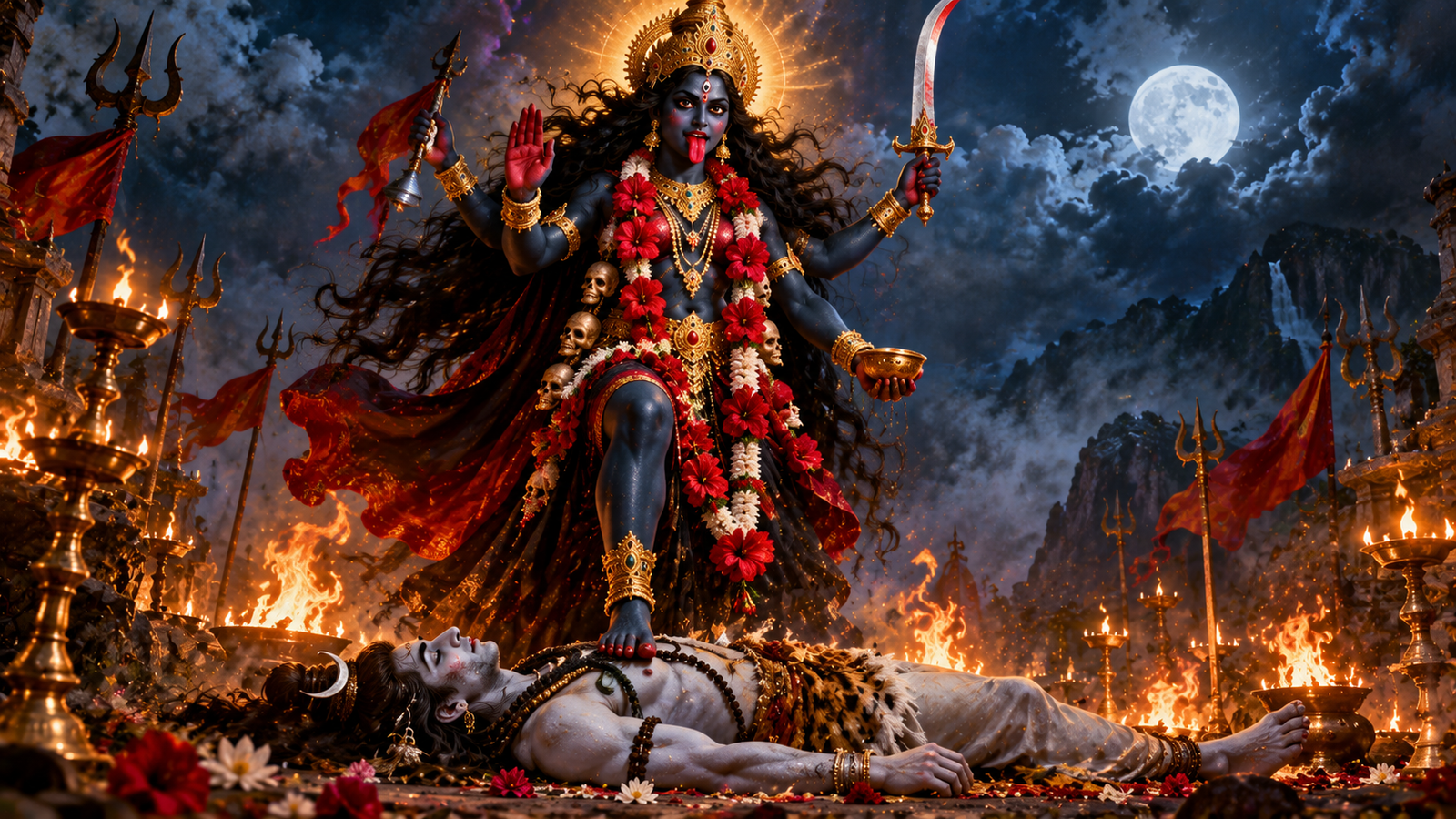
Kali is the most striking of all Hindu images. She is deep blue-black, clad only in a skirt of severed human arms, with wild flowing hair and three eyes that see the past, present and future. Around her neck hangs a garland of fifty severed heads, read as the fifty letters of the Sanskrit alphabet, the sounds from which all creation is woven. In her best-known four-armed form she holds a bloodied sword (khadga) and a freshly severed head in her left hands, while her right hands make the gestures of fearlessness (abhaya) and of boons (varada): she takes life with one side and grants fearlessness with the other. Her red tongue lolls from her mouth, and she stands with one foot upon the white, still body of Shiva.
Why does Kali stand on Shiva?
The image of Kali upon Shiva carries two meanings. In the popular story, after slaying Raktabija she was so drunk on the frenzy of battle that her dance threatened to shatter the earth, and none could stop her. Shiva, her husband, lay down among the corpses in her path; when she trod upon him and saw whom she had stepped on, she bit her tongue in surprise and shame, and her fury ceased. In the deeper Tantric reading, Shiva is pure, changeless consciousness, lying still as a corpse (shava) without her, while Kali is Shakti, the active power that alone can move and create. She dances upon him to show that spirit without power is inert and power without spirit is blind; the two together are the whole of reality.
Kali in Tantra and the ten Mahavidyas
Kali is the foremost of the Dasha Mahavidyas, the ten great wisdom goddesses of Tantra, and for many Tantric schools she is the supreme reality, Adya Kali, the primordial Goddess from whom the others flow. Tantra does not flee from what frightens; it teaches the seeker to meet death, time and the cremation ground directly, and Kali, who presides over all three, is its central deity. Her worship ranges from the household devotion of millions to the austere rites of the cremation ground, where the yogi confronts mortality itself in her presence.
The terrible Mother who is tender
For all her terror, Kali is beloved above all as a mother. In Bengal her worship was transformed by the poet-saints Ramprasad Sen and Kamalakanta, whose Shyama Sangeet address her with astonishing intimacy, scolding, pleading, teasing and adoring the dark Mother as a child does its own. In the nineteenth century the mystic Sri Ramakrishna of the Dakshineswar temple lived in ceaseless vision of Kali as the living Mother of the universe. Her fearsome form is read as a mother’s love: she wears death as an ornament so that her children need not fear it, and her nakedness is her refusal of every disguise.
The many forms of Kali
Kali is worshipped in many forms, among them Dakshina Kali, the gentlest and most common, who grants boons; Bhadrakali, the auspicious and protective; Shmashana Kali, the Kali of the cremation ground; Mahakali, the vast cosmic form identified with the power behind Vishnu’s cosmic sleep; Guhyakali, the secret Kali of the Tantras; and Chamunda, the gaunt slayer of demons. The great temples each hold their own cherished form of her.
How is Kali worshipped?
Kali’s chief festival is Kali Puja, kept on the new-moon night of Kartik, the same night as Diwali, above all in Bengal, Assam and Odisha, with worship at midnight (nishita). She is offered red hibiscus flowers, which recall her tongue and her garland, along with sweets and, in some temples, animal sacrifice, though many now offer symbolic substitutes such as pumpkins and gourds. Tuesdays and Saturdays are sacred to her, and her best-loved mantra is Om Krim Kalikayai Namah. Her worship is strongest in the Shakta tradition, which holds the Goddess to be the supreme deity.
Temples of Kali
Among her most revered shrines are Kalighat and Dakshineswar in Kolkata; the Kamakhya temple in Assam, one of the greatest Shakta pithas; Tarapith in Bengal, a famed cremation-ground shrine; and countless village and household shrines across eastern and southern India. The name of the city of Kolkata (Calcutta) is itself often traced to Kalighat, the ghat of Kali.
या देवी सर्वभूतेषु शक्तिरूपेण संस्थिता। नमस्तस्यै नमस्तस्यै नमस्तस्यै नमो नमः॥
To the Goddess who abides in all beings as power, salutations to her, salutations, salutations again and again.