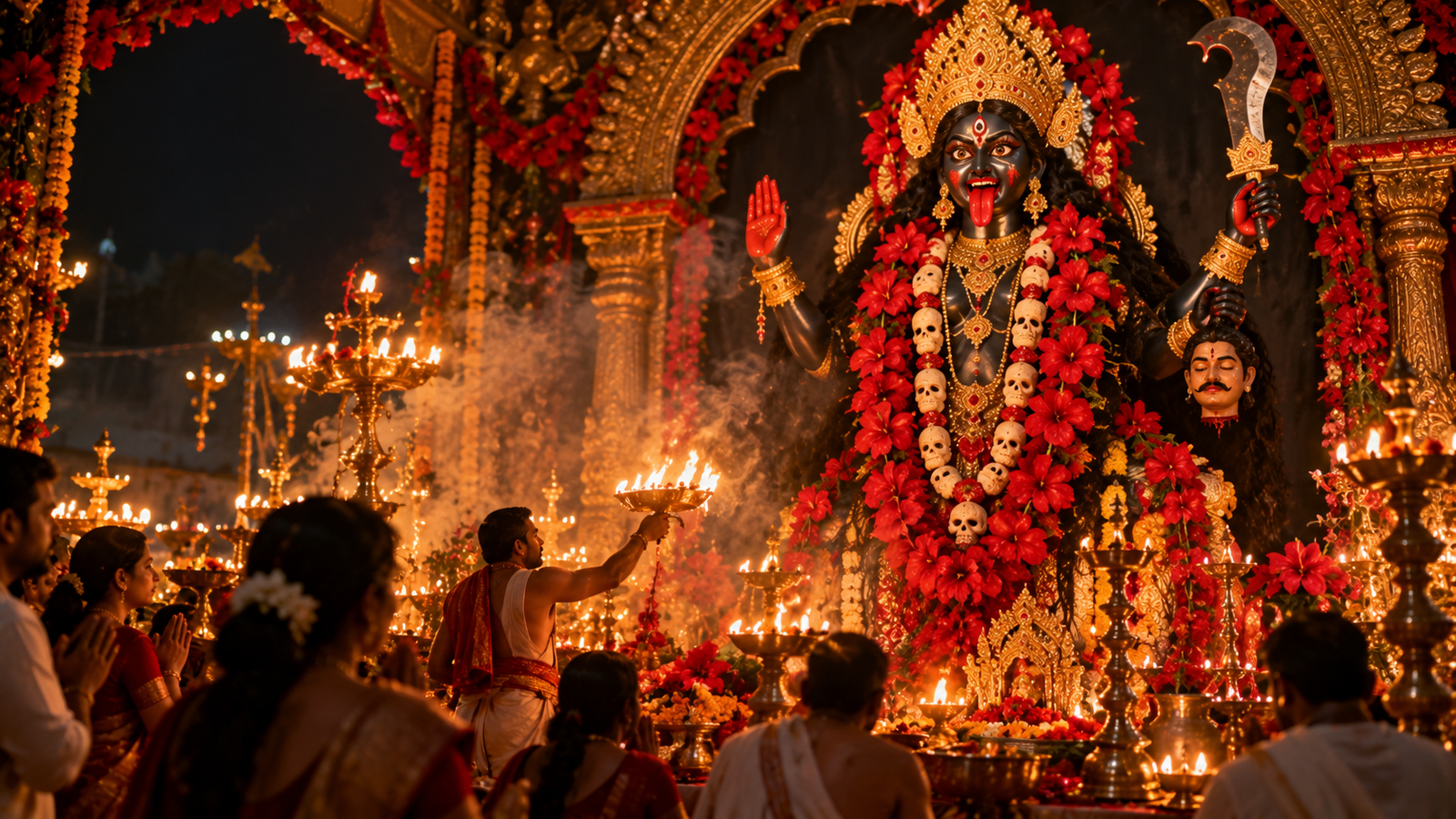
Kali Puja
काली पूजाKali Puja, or Shyama Puja, is the worship of the goddess Kali on the new-moon night of Kartik, the night of Diwali. While the rest of India worships Lakshmi, Bengal, Assam and Odisha worship the fierce Mother at midnight for protection and fearlessness, above all at Kalighat and Dakshineswar.
What is it?
The worship of the fierce goddess Kali on the new-moon night of Kartik, the same night as Diwali, kept above all in Bengal, Assam and Odisha with midnight Tantric worship.
Why is it celebrated?
To seek the protection, courage and liberation of the dark Mother on the darkest night of the year, when she is believed to be nearest.
How is it observed?
- 1Installation of Kali's clay image
- 2Offering of red hibiscus, sweets, rice and lentils (and in some traditions fish or meat, or symbolic substitutes)
- 3Midnight (nishita) Tantric worship
- 4Lamps, incense, conch and drum through the night
- 5Breaking the fast after the midnight puja
Kali Puja (Bengali: কালী পূজা) is the great festival of the goddess Kali, kept on the new-moon night of the month of Kartik, the darkest night of the year and the same night on which much of India lights the lamps of Diwali. While most of the country worships Lakshmi for prosperity on this night, Bengal, Assam, Odisha and the eastern regions turn to Kali, the fierce Mother, calling upon her in the deep of the night for protection, courage and liberation.
What is Kali Puja?
Kali Puja, also called Shyama Puja, is the worship of the dark goddess at the moment when darkness is deepest, the amavasya (new moon) of Kartik. The idea behind it is striking: on the night the world fears most, the devotee turns toward the goddess of night and death herself, and finds in her not terror but a mother’s protection. Large clay images of Kali are installed in homes, temples and public pandals, and worshipped from late evening through midnight.
When and where is it celebrated?
Kali Puja falls on Kartik Amavasya (October or November), twenty days after Vijayadashami and on the night of Diwali. It is among the greatest festivals of the year in West Bengal alongside Durga Puja, and is kept with equal devotion in Assam, Tripura, Odisha and Bihar, and among eastern communities everywhere. Its spiritual heart is the family of temples around Kolkata, above all Kalighat and Dakshineswar, and the Kamakhya temple in Assam.
The midnight worship
Unlike most pujas, Kali Puja reaches its height at midnight, in the hour called nishita, when the goddess is believed to be nearest. The worship follows the Tantric form, with the offering of red hibiscus flowers whose colour recalls Kali herself, along with sweets, rice and lentils, and in some traditions fish and meat; a few temples still keep the old rite of animal sacrifice, though many households and reformed temples now offer symbolic substitutes such as pumpkins, sugarcane or gourds. Lamps, incense and the sound of conch and drum fill the night, and the fast is broken only after the midnight worship is complete.
Why Kali and not Lakshmi?
On the same new-moon night, two very different visions of the divine feminine are honoured across India. In the north and west, Lakshmi, the gentle goddess of wealth and grace, is welcomed into clean, lamp-lit homes. In the east, Kali, the fierce goddess who destroys evil and fear, is called upon in the darkness. Both are forms of the one Goddess, and both answer the same human longing on the longest night: the north asks for abundance, the east for fearlessness. In Gujarat and parts of the west the day before Diwali is kept as Kali Chaudas, a related worship of the fierce goddess to drive away evil.
Other ways Kali is worshipped
Beyond her great festival, Kali is worshipped through the year. Tuesdays and Saturdays are especially sacred to her, when devotees visit her temples, offer red flowers and light lamps. Her mantra Om Krim Kalikayai Namah is recited for protection and for the cutting away of fear and ego. In the Tantric tradition she is approached through initiation and the disciplines of her sadhana, and cremation-ground shrines such as Tarapith keep the oldest and most austere forms of her worship. The story from which her whole worship flows is told in Kali and Raktabija.
Frequently asked questions
What is Kali Puja?
When is Kali Puja celebrated?
Why is Kali worshipped on Diwali night?
How is Kali Puja performed?
Where is Kali Puja celebrated most?
What is Kali Chaudas?
Sources
- Devi Mahatmya and the Shakta Puranas
- Bengali Tantric and temple traditions (Kalighat, Dakshineswar)
- Accounts of Krishnananda Agamavagisha, who is credited with popularising household Kali Puja
- Wikipedia, "Kali Puja" (accessed Oct 2026)
Read our editorial policy on how scripture, Purana and folk tradition are labelled.