Chhath Puja
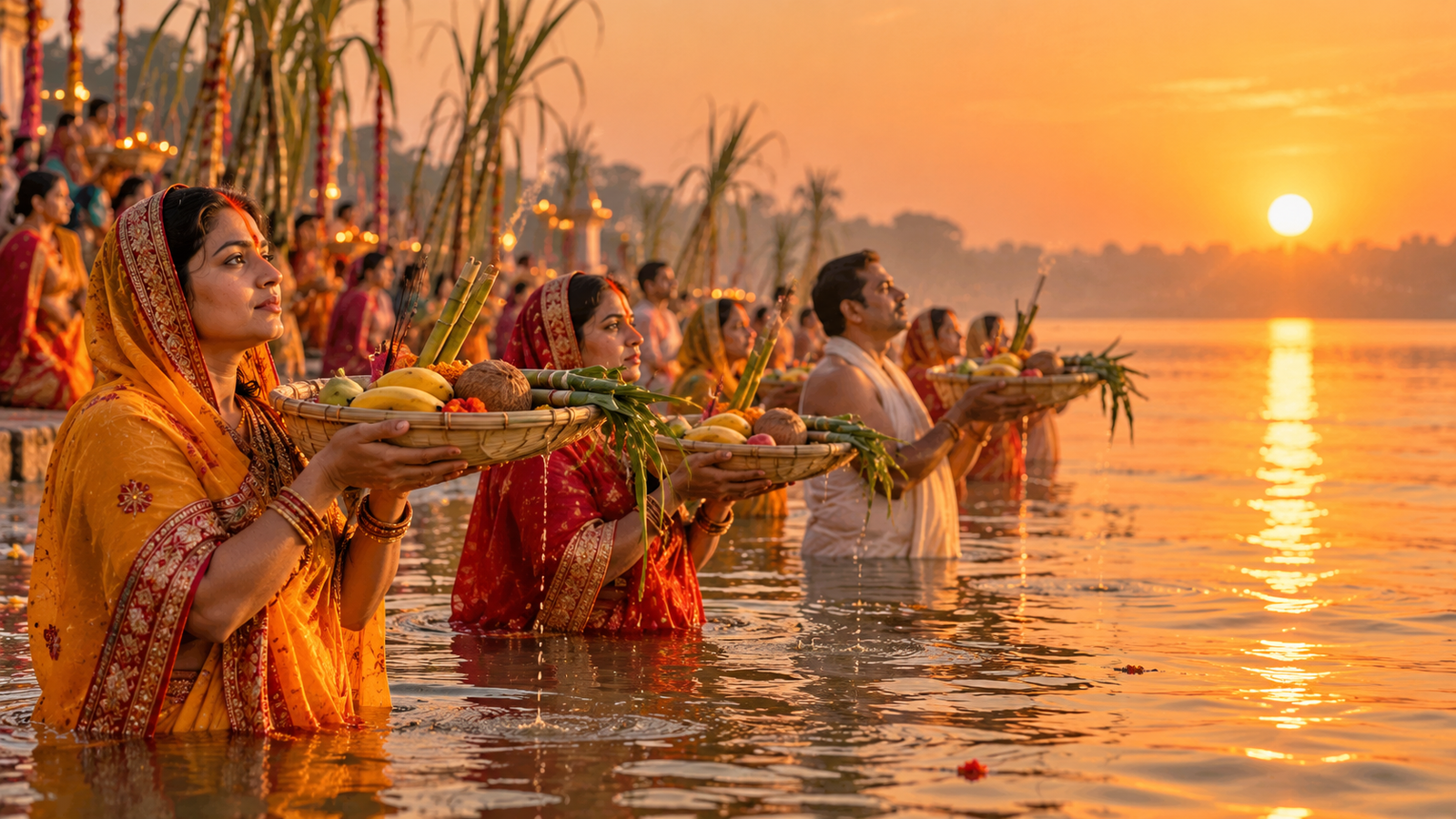
छठ पूजाChhath Puja is a four-day festival of thanksgiving to Surya the Sun god and Chhathi Maiya, kept in Bihar, Jharkhand, eastern UP and Nepal. Without priests or idols, devotees fast and stand in water to offer arghya to the setting and rising Sun over the days of Nahay Khay, Kharna, Sandhya Arghya and Usha Arghya.
What is it?
A four-day festival of thanksgiving to Surya the Sun god and Chhathi Maiya, kept mainly in Bihar, Jharkhand, eastern Uttar Pradesh and Nepal, in which worshippers stand in water and offer arghya to the setting and rising Sun.
Why is it celebrated?
To thank the Sun, the visible source of life and health, and to seek the wellbeing and long life of one's family through a vow of purity and fasting.
How is it observed?
- 1Nahay Khay: ritual bathing and a single simple meal
- 2Kharna: a day-long fast broken at dusk with jaggery kheer, after which the waterless fast begins
- 3Sandhya Arghya: standing in water to offer arghya to the setting Sun with a soop of fruits and thekua
- 4Usha Arghya: the same offering to the rising Sun, breaking the thirty-six-hour fast
Chhath Puja (Hindi: छठ पूजा) is one of the oldest and most austere festivals of Hinduism, a four-day celebration of thanksgiving offered to Surya, the Sun god, and to Chhathi Maiya, the goddess who protects children and grants wellbeing. Kept above all in Bihar, Jharkhand, eastern Uttar Pradesh and the Terai of Nepal, it is a festival without priests, idols or temples: the worshippers stand in a river or pond and offer their prayers directly to the Sun they can see.
What is Chhath Puja?
Chhath is a vow (vrat) of gratitude to the Sun, the visible source of all life, health and energy. The one who keeps it, usually a woman and called the vrati, undertakes days of strict purity, fasting and discipline for the welfare of her family. The festival honours Surya together with Chhathi Maiya, regarded as the sixth form of the divine mother, worshipped on the sixth day of the lunar fortnight, from which the festival takes its name, for chhath means “sixth”.
The four days of Chhath
Chhath unfolds over four days of rising devotion:
- Nahay Khay (day one): the vrati bathes, cleans the home and eats a single simple, sattvic meal, usually rice, chana dal and bottle gourd.
- Kharna or Lohanda (day two): a day-long fast ending at dusk with kheer of jaggery, roti and fruit; after this meal the long fast without food or water begins.
- Sandhya Arghya (day three): the central day. At sunset the family goes to the riverbank, and the vrati stands waist-deep in water to offer arghya, water and milk poured toward the setting Sun, with a bamboo basket (soop) of fruits, sugarcane and the special sweet thekua.
- Usha Arghya (day four): before dawn the family returns to the water and makes the same offering to the rising Sun. With this the fast, which lasts around thirty-six hours without water, is broken.
Why is Chhath celebrated?
At its heart Chhath is simple gratitude: thanks to the Sun for life itself. Several stories are told of its origin. One holds that Karna, the son of Surya, was the first to worship his father by standing in water and offering arghya, a practice his people continued. Another connects the vrat to Draupadi and the Pandavas, who are said to have kept it to regain their fortunes, and others to Sita and to the daughter-in-law of King Priyavrata, who was blessed with a child by Chhathi Maiya. Through all of them runs one theme: the Sun rewards purity, patience and gratitude with health and the continuance of the family.
Other ways Surya is worshipped
Beyond Chhath, Surya is honoured through the year:
- Ratha Saptami, on the seventh day of the waxing moon in Magha, marks the Sun’s chariot turning toward the north and is kept as Surya’s symbolic birthday.
- Makar Sankranti, in January, celebrates the Sun entering Capricorn and beginning its northward journey (Uttarayana), observed with holy bathing, kite-flying and sweets of sesame and jaggery.
- Samba Dashami, in Odisha, recalls Samba, the son of Krishna, who was cured of his affliction by worshipping the Sun.
- Daily worship: the sunrise Arghya, the twelve postures of Surya Namaskar, the Gayatri mantra, the mantra Om Suryaya Namah, and the recitation of the Aditya Hridayam, the hymn Agastya taught Rama in the Ramayana.
- Sunday is kept by many as a fast for Surya, taking one meal, wearing red and offering red flowers, wheat and jaggery.
The spirit of the vrat
What sets Chhath apart is its utter simplicity and its nearness to nature. There is no idol and no priest; the offerings are fruits, sugarcane and home-made thekua carried in bamboo baskets; the place of worship is a river or pond; and the discipline of standing for long hours in cold water and fasting without even water is undertaken with joy. For the communities that keep it, Chhath is the purest expression of the bond between human life and the Sun that sustains it. Its story is told in full on the story of Surya and the birth of Karna.
Frequently asked questions
What is Chhath Puja?
When is Chhath Puja celebrated?
Who is worshipped during Chhath?
What are the four days of Chhath?
Why is Chhath considered so strict?
How is Karna connected to Chhath?
Sources
- Puranic and folk traditions of Surya worship
- Valmiki Ramayana, Yuddha Kanda (Aditya Hridayam)
- Regional Chhath vrat-katha traditions of Bihar and eastern India
- Wikipedia, "Chhath" (accessed Oct 2026)
Read our editorial policy on how scripture, Purana and folk tradition are labelled.