The story
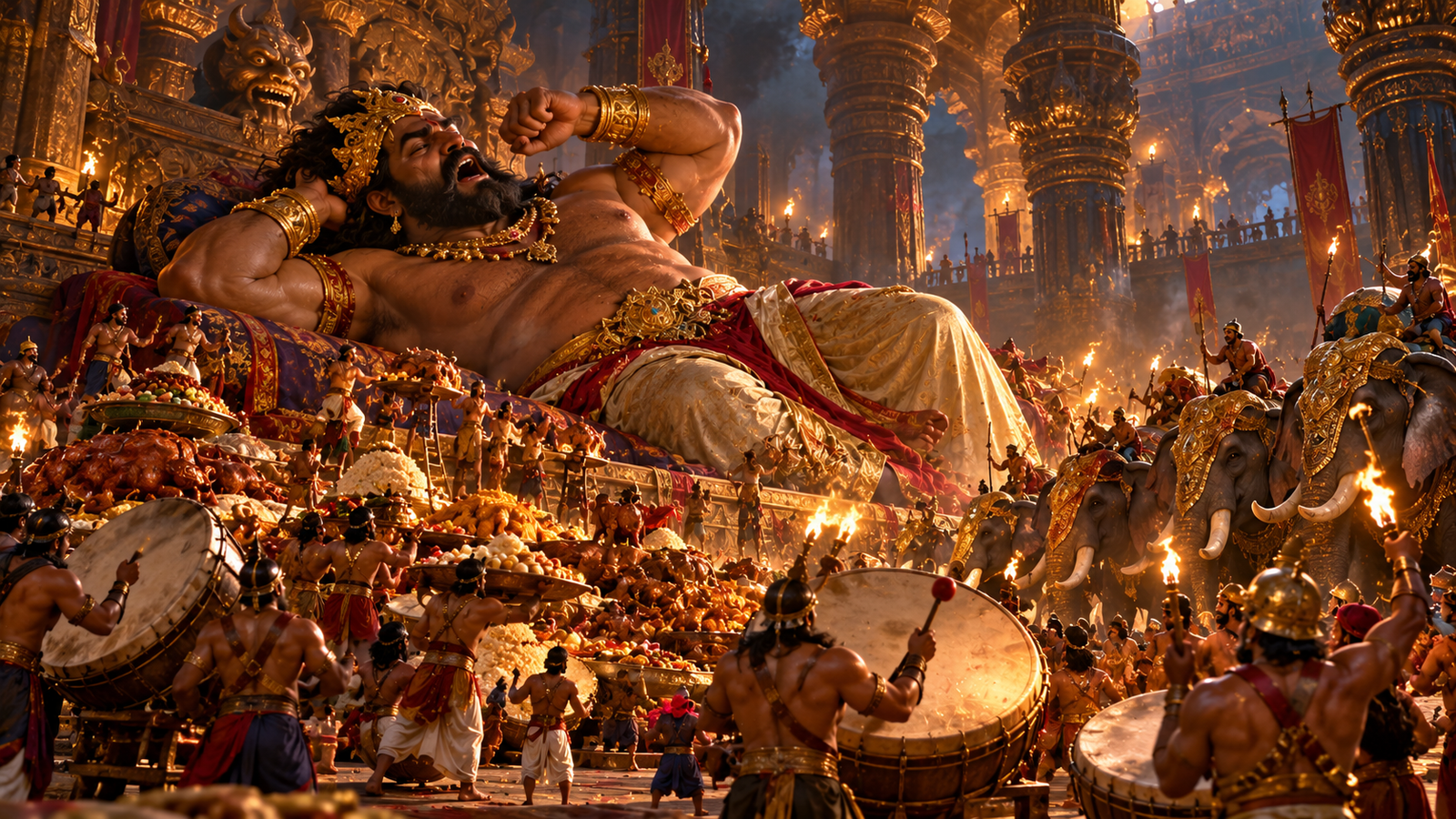
As the war for Lanka turned against him, Ravana turned to his last and most fearsome hope: his colossal brother Kumbhakarna, who slept for six months of every year and had to be woken before his time. The awakening of Kumbhakarna is one of the most vivid episodes of the Ramayana, and also one of its most tragic.
The boon that became a curse
Long before the war, Kumbhakarna had performed terrible austerities alongside Ravana, and Brahma came to grant him a boon. He had meant to ask for Indrasana, the seat of Indra, or for deathlessness, but the goddess Saraswati, at the request of the frightened gods, turned his tongue as he spoke, so that he asked instead for Nidrasana, for sleep. Brahma granted it: Kumbhakarna would sleep for six months at a stretch and wake for only a single day, for a slip of the tongue had changed the course of his life.
The rousing of the giant
When Ravana’s commanders fell one after another, he ordered that Kumbhakarna be woken, though his time to wake had not come. It took an army to rouse him: mountains of food were piled before him, elephants were made to walk over his body, drums and conches were sounded in his ears, and warriors tore at him, until at last the mountain-like demon stirred, yawned, and rose.
The counsel of a loyal brother
Woken and told of the war, Kumbhakarna did not rejoice. He rebuked Ravana openly for the sin of carrying off Sita and warned that it would bring the ruin of them all. Yet he was a brother first, and having spoken the truth, he declared that he would not abandon Ravana in his hour of need; he would go out and fight, and if he must, die for his brother and his city.
Kumbhakarna in battle
Onto the field strode a demon tall as a hill, and terror went before him. He scattered the vanara host, crushed their ranks and even swept up warriors by the handful, and for a time none could stand against him; he overcame Sugriva and withstood the blows of Hanuman himself. At last Rama faced him. With celestial weapons Rama cut away the giant’s arms and then his legs, and finally, with a blazing astra, struck off his vast head, so that it fell into the sea and the earth shook. So died the loyal brother, fighting for a cause he knew to be wrong.
The meaning of the story
Kumbhakarna’s tale is a study of loyalty and its limits. He is given the rarest gift of the epic, the courage to tell his all-powerful brother the plain truth, and yet he chooses the bond of blood over his own clear sight and goes to a death he has foreseen. His story asks a hard question that the epics never fully answer: when loyalty to one’s own is set against the demands of dharma, which must a good person follow? And it remembers, with sorrow, the greatness that is wasted in the service of a wrong cause.
Meaning and lessons
The story weighs loyalty against dharma. Kumbhakarna has the rare courage to tell his all-powerful brother the truth, yet chooses blood over his own clear sight and dies for a cause he knows is wrong. It asks which a good person should follow when loyalty and dharma conflict, and mourns greatness wasted in a wrong cause.
Frequently asked questions
Why did Kumbhakarna sleep for six months?
How was Kumbhakarna woken?
Did Kumbhakarna support the abduction of Sita?
How did Kumbhakarna die?
What does the story teach?
Sources
- Valmiki Ramayana, Yuddha Kanda
- Ramcharitmanas of Tulsidas, Lanka Kanda
- Wikipedia, "Kumbhakarna" (accessed Oct 2026)
Read our editorial policy on how scripture, Purana and folk tradition are labelled.