Quick answer
Alambusha and Alayudha in the Mahabharata: the rakshasas who fought for Duryodhana, how Alambusha killed Iravan, and how Ghatotkacha slew both in the night war.
Who is in this story
The story
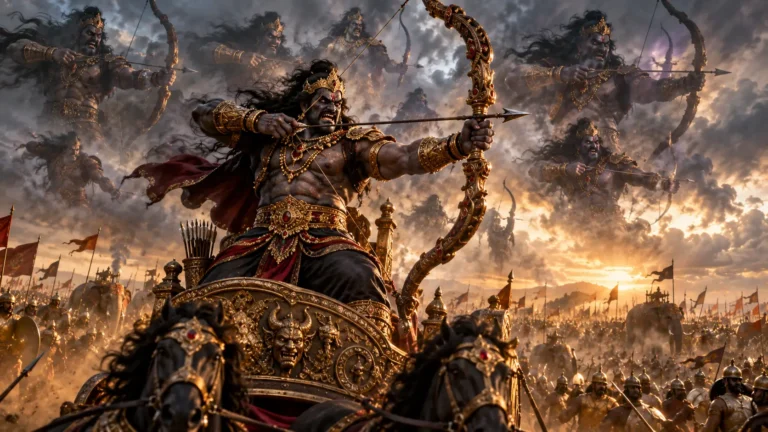
Alambusha and Alayudha are two rakshasas who fought for Duryodhana in the Kurukshetra war. Both were masters of illusion, both carried a grudge against Bhima, and both died at the hands of Bhima’s son Ghatotkacha during the night battle of the fourteenth day. This guide tells their stories, including how Alambusha killed Arjuna’s son Iravan, and explains why their deaths mattered to the outcome of the war.
Who was Alambusha?
Alambusha was a rakshasa skilled in both weapons and maya, the power of illusion. The Mahabharata survives in many manuscripts, and its versions differ on his family: some call him the son of Jatasura, a rakshasa Bhima killed during the exile, and others the brother of Baka, whom Bhima killed earlier. Either way, he had reason to hate Bhima and joined the Kaurava side. During the war he fought Abhimanyu, Satyaki and Bhima at different times.
Alambusha and the death of Iravan
Iravan was the son of Arjuna and the Naga princess Ulupi. On the eighth day of the war, Iravan killed several of Shakuni’s brothers, and Duryodhana sent Alambusha to stop him. The two fought a battle of illusions. When Iravan’s Naga kin came to his aid, Alambusha took the form of Garuda, the eagle who is the enemy of serpents, scattered them and killed Iravan. Arjuna grieved deeply for his son.
Tamil tradition tells a different story of Iravan, known there as Aravan, who offers himself as a sacrifice before the war to secure the Pandavas’ victory. He is honoured at the annual festival at Koovagam in Tamil Nadu. That account belongs to regional tradition and is not in the Sanskrit epic.
Who was Alayudha?
Alayudha was a powerful rakshasa who came to Duryodhana on the fourteenth night, offering to destroy the Pandavas. He held a grudge against Bhima for killing rakshasas of his kin and circle, including Baka, Hidimba and Kirmira. Duryodhana welcomed him gladly, since the Pandavas’ rakshasa ally Ghatotkacha was causing havoc. Alayudha should not be confused with Ghatotkacha’s son Anjanaparvan, whom Ashwatthama killed.
The night battle of the fourteenth day
After Jayadratha’s death, the fighting went on into the night against the usual rules of war. Rakshasas were said to grow stronger in the dark, and the battle became a contest of illusions. Alambusha attacked Ghatotkacha, and the two matched each other’s maya until Ghatotkacha overpowered and killed him. Alayudha then fought Bhima and Ghatotkacha in turn, and Ghatotkacha brought him down too, to the dismay of the Kaurava army.
Why Alambusha and Alayudha matter
With both of his rakshasa champions dead, Duryodhana grew desperate and begged Karna to stop Ghatotkacha at any cost. Karna used the Vasavi Shakti, the one-use divine weapon he had kept for Arjuna, and Ghatotkacha fell. That chain of events left Arjuna safe and helped decide the war, which is why Krishna was relieved. The stories of Alambusha and Alayudha are short, but they set up one of the epic’s turning points.
Read more
To explore the epic, start with the Mahabharata library. For the hard choices at the heart of the war, read who the real hero of the Mahabharata is, and see how Dronacharya fell on the following day.
Frequently asked questions
Who killed Iravan in the Mahabharata?
Alambusha, a rakshasa fighting for the Kauravas, killed Iravan on the eighth day by taking the form of Garuda against Iravan’s serpent allies.
Who killed Alambusha and Alayudha?
Ghatotkacha, the son of Bhima, killed both of them during the night battle of the fourteenth day.
Who was Alayudha?
Alayudha was a rakshasa who joined Duryodhana on the fourteenth night, holding a grudge against Bhima for killing Baka, Hidimba and Kirmira.
Sources and further reading
- Mahabharata, Drona Parva, translated by K. M. Ganguli (Section CVIII)
- Mahabharata, Bhishma Parva (death of Iravan) and Drona Parva (night battle)
Read our editorial policy on how scripture, Purana and folk tradition are labelled.