Nishkama Karma
निष्काम कर्मNishkama karma is acting with full effort but without clinging to the outcome. It is the Gita's central practical teaching, stated most famously in verse 2.47.
What is Nishkama Karma?
Nishkama karma means action without craving for its results. The person gives full effort to the work in front of them, then accepts whatever comes, success or failure, with a steady mind. It is the central practical teaching of the Bhagavad Gita.
What nishkama karma means
The term joins nishkama, “without desire for fruit”, and karma, “action”. It does not mean doing nothing or not caring. It means separating the quality of the effort from the demand that the world reward it. The opposite, sakama karma, is action driven by the wish for a particular payoff.
The teaching in the Gita
The key verse is 2.47: Krishna tells Arjuna that his right is to the work only, never to its fruits, that fruits should not be his motive, and that he should not drift into inaction either. 2.48 adds that one should act steadily, treating success and failure alike. 3.19 says that one who acts without attachment reaches the highest, and 5.10 compares such a person to a lotus leaf that stays dry in water. The teaching is developed in Chapter 3.
Common misreadings
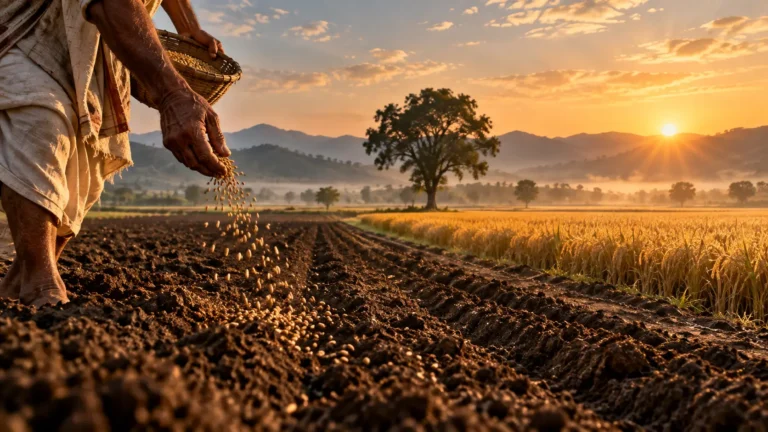
It is not indifference to outcomes: a farmer still plants carefully and a doctor still plans treatment. It is also not a recipe for laziness, since 2.47 warns against inaction. What changes is the inner posture, so that fear of failure and hunger for praise stop bending the work.
Where it fits
Nishkama karma is the heart of karma yoga (see yoga). It is lived out through one’s svadharma, and it grows into the evenness of the sthitaprajna. By loosening the tie between action and craving, it changes how karma binds a person.
Nishkama karma is action done without craving for its results: full effort in the work and calm acceptance of the outcome.
Where it appears in the texts
The teaching is stated in Bhagavad Gita 2.47 and developed through Chapter 3 and Chapter 5.
Connected to Nishkama Karma
 Related figuresKarmaकर्म
 Related figuresDharmaधर्मRelated figuresSvadharmaस्वधर्मRelated figuresYogaयोगRelated figuresSthitaprajnaस्थितप्रज्ञRelated figuresBhagavad Gita 18.2भगवद् गीता 18.2Related figuresBhagavad Gita 6.1भगवद् गीता 6.1Related figuresBhagavad Gita 15.3भगवद् गीता 15.3Related figuresBhagavad Gita 18.6भगवद् गीता 18.6Related figuresBhagavad Gita 3.7भगवद् गीता 3.7Related figuresBhagavad Gita 18.9भगवद् गीता 18.9Related figuresBhagavad Gita 18.17भगवद् गीता 18.17