Quick answer
Matsya avatar story: Vishnu's first avatar as a fish who saved Manu from the great flood, guided the boat of life and rescued the Vedas, from the Shatapatha Brahmana to the Puranas.
Who is in this story
The story
Matsya, the fish, is the first of Vishnu’s ten avatars and the hero of India’s great flood story. As a tiny fish he asked a king for protection, grew to an enormous size, warned of a coming deluge and guided a boat carrying the seeds of life to safety. This guide tells the Matsya avatar story as the Puranas record it, traces it back to the oldest Vedic version, and explains what it means.
Matsya avatar story: the tiny fish
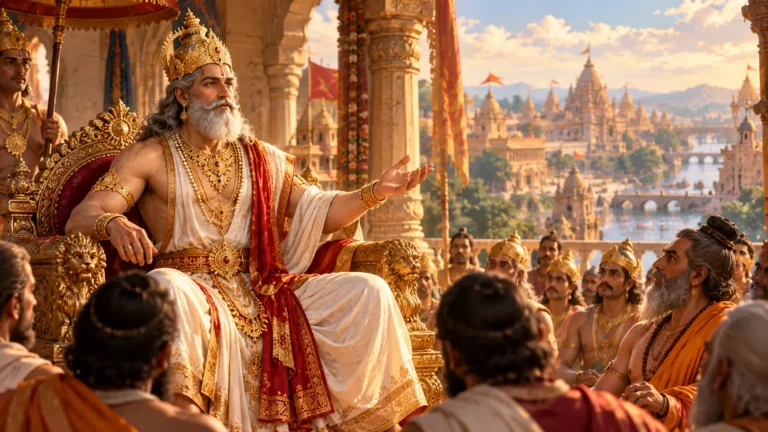
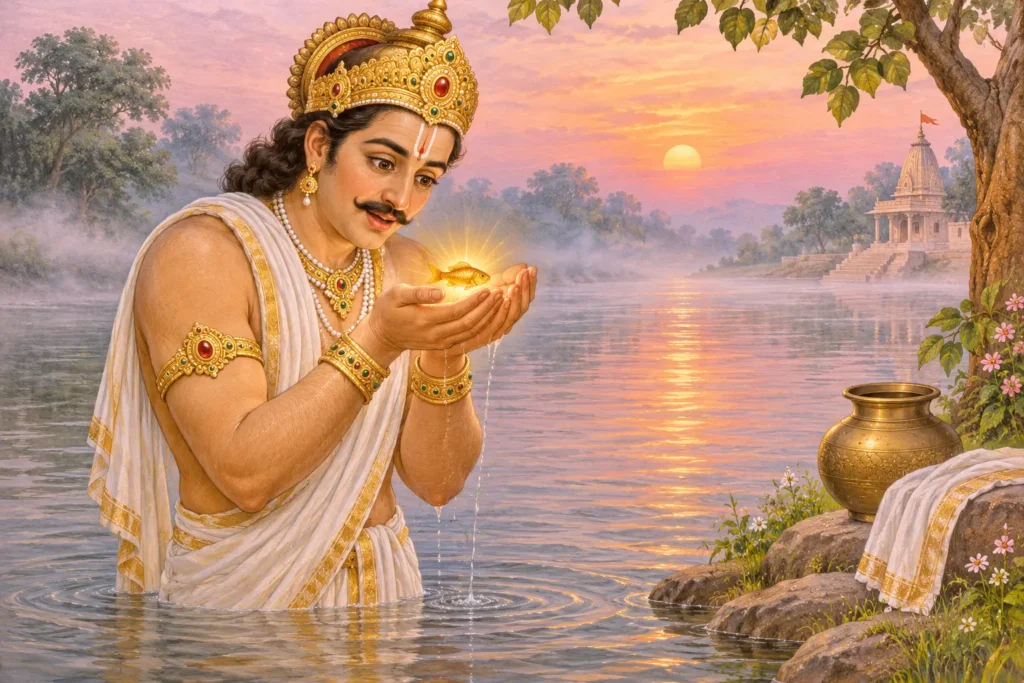
The Bhagavata Purana tells of King Satyavrata, a devout ruler who would later become Vaivasvata Manu, the father of the present age of humanity. One morning, while offering water in the Kritamala river, he found a tiny fish in his cupped hands. The fish begged him not to throw it back, fearing the larger fish. The king placed it in his water pot.
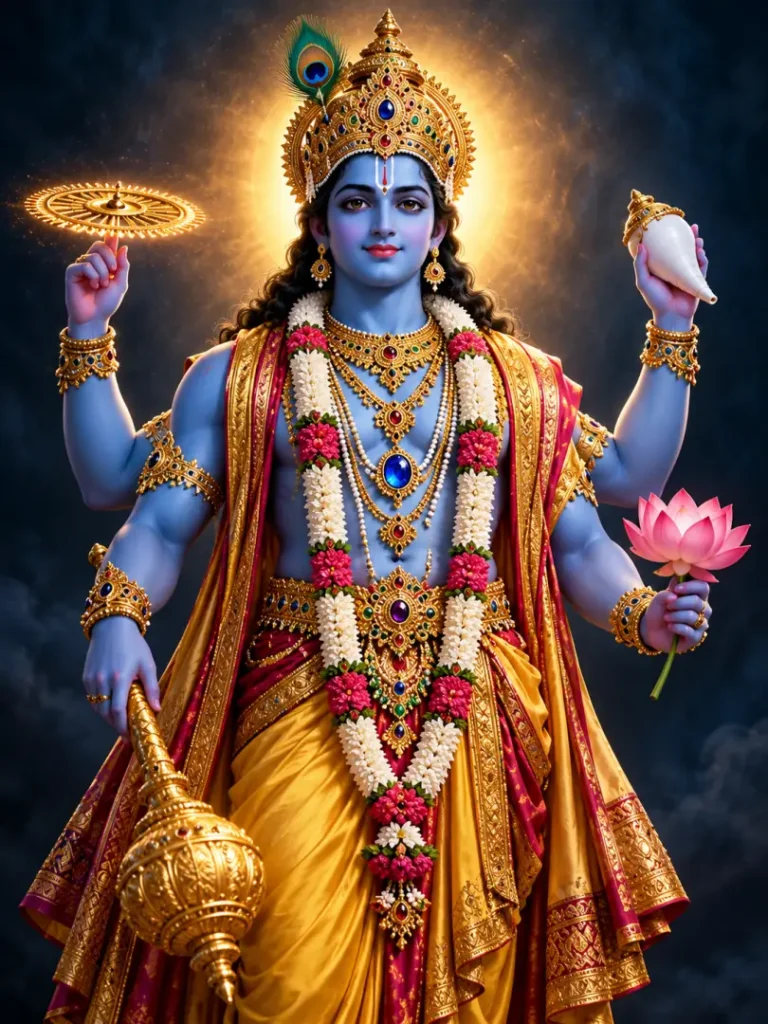
By the next day it had outgrown the pot, so he moved it to a well, then a pond, then a lake and finally the ocean, and each time it filled the space. Realising this was no ordinary fish, the king asked who it was. The fish revealed himself as Vishnu.
The warning and the boat
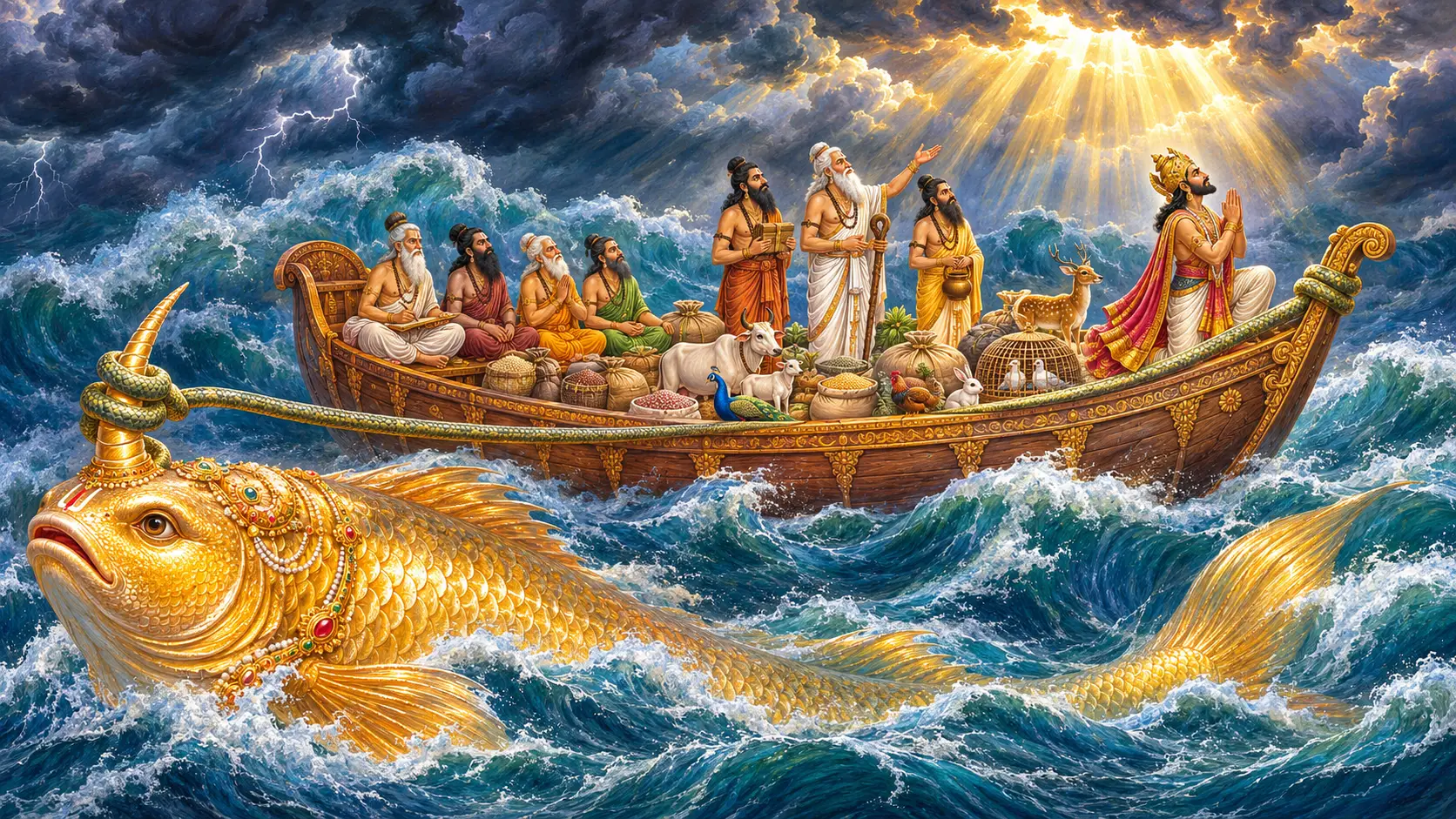
Matsya told the king that in seven days a great flood would cover the three worlds. A boat would come to him, and he was to board it with the seven sages, all kinds of seeds and pairs of living beings. When the waters rose, the boat arrived as promised. Matsya appeared as a vast golden fish with a single horn, and the king tied the boat to the horn using the great serpent Vasuki as a rope. Through the long night of the deluge, Matsya towed the boat safely and taught the king spiritual knowledge, which the Puranas preserve as the Matsya Purana.
Rescuing the Vedas
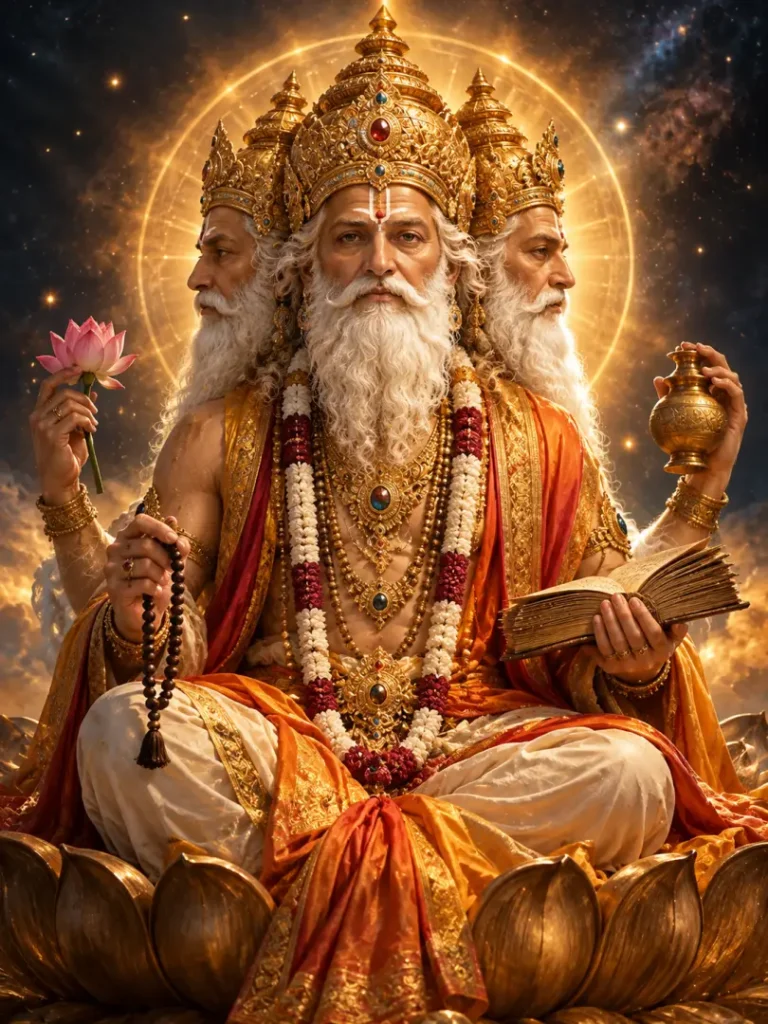
The Puranas add that at the same time an asura named Hayagriva stole the Vedas as Brahma was falling asleep at the end of a cosmic day. Matsya killed Hayagriva and returned the Vedas to Brahma, so that knowledge as well as life survived the flood. (This Hayagriva is an asura, different from the horse-headed form of Vishnu worshipped by the same name.)
The oldest version: Shatapatha Brahmana
The earliest form of the story appears in the Shatapatha Brahmana, a Vedic text much older than the Puranas. There Manu finds a small fish while washing, raises it, and is warned of a flood. He builds a ship, ties it to the fish’s horn and is carried to a northern mountain. In this version the fish is not yet named as Vishnu, and the Puranas later identify it with Vishnu’s first avatar.
Flood stories around the world
Readers often compare the Matsya story with other flood narratives, such as the story of Noah in Genesis and the Mesopotamian epic of Gilgamesh, all of which tell of a chosen survivor, a boat and the renewal of life. Scholars discuss these parallels in different ways, and each tradition gives the flood its own meaning. In the Hindu telling, the emphasis falls on divine protection, the preservation of knowledge and the start of a new cycle.
Matsya Jayanti and worship
Matsya Jayanti is observed on the third day of the bright half of Chaitra, and some temples, such as the Shri Vedanarayana Swamy Temple at Nagalapuram in Andhra Pradesh, are dedicated to Vishnu in his Matsya form.
What the Matsya avatar teaches
A small creature asking for help turns out to be the divine itself, and the king’s kindness becomes the reason the world survives. The story honours compassion, faith and the protection of knowledge.
Frequently asked questions
What is the Matsya avatar?
Matsya is Vishnu’s first avatar, a fish who warned Manu of a great flood, towed his boat to safety and recovered the stolen Vedas.
Where is the Matsya story told?
The earliest version is in the Shatapatha Brahmana, and fuller accounts appear in the Bhagavata Purana and Matsya Purana.
When is Matsya Jayanti celebrated?
Matsya Jayanti falls on Chaitra Shukla Tritiya, the third day of the bright half of Chaitra.
Sources and further reading
- Hindu texts index, Sacred Texts (Shatapatha Brahmana, Puranas)
- Shatapatha Brahmana 1.8.1; Bhagavata Purana 8.24; Matsya Purana
Read our editorial policy on how scripture, Purana and folk tradition are labelled.