Nandi
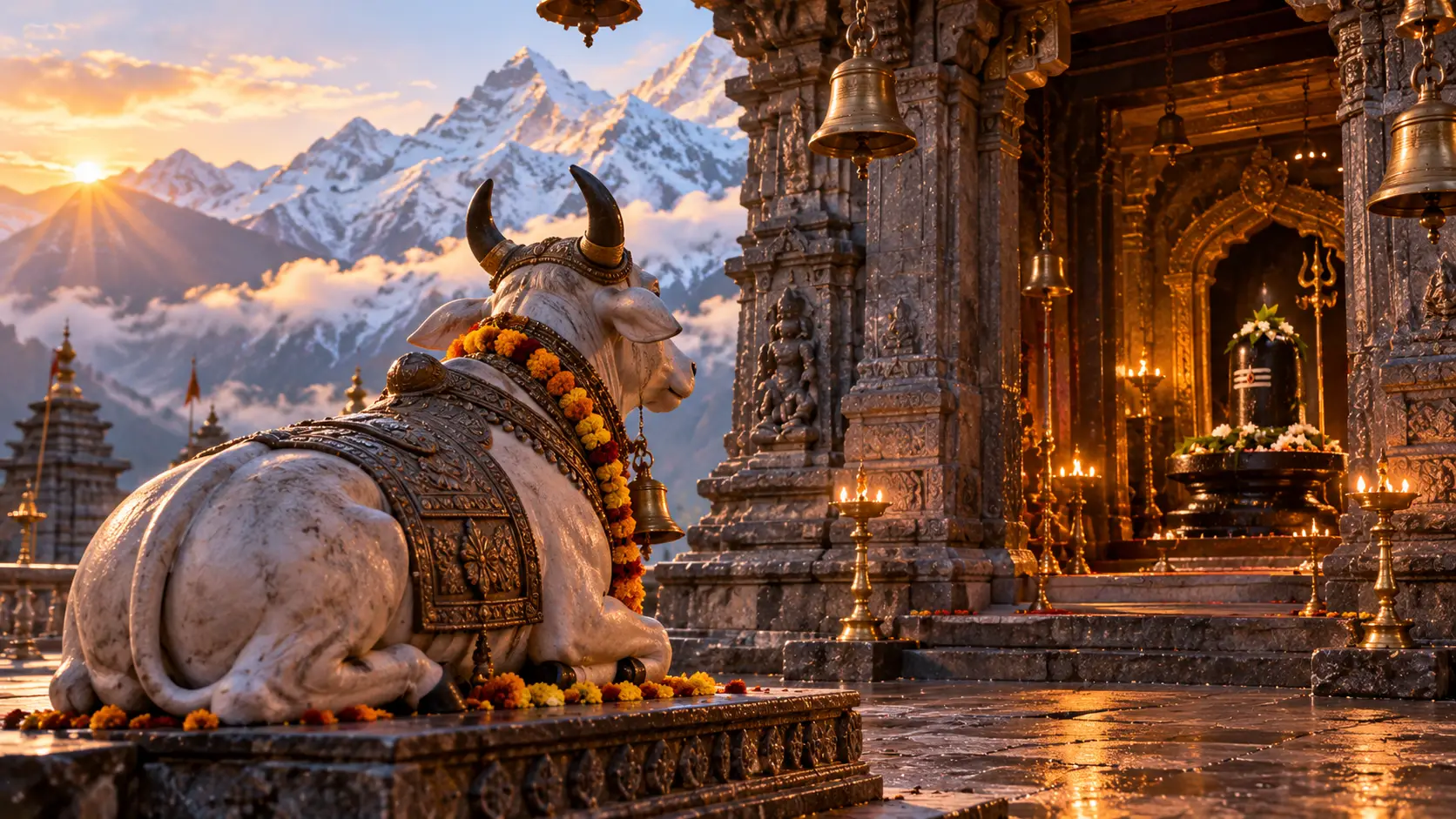
नंदीNandi is the sacred bull who carries Shiva and guards the gate of Kailash as chief of Shiva's ganas. Born to the sage Shilada through Shiva's boon, he kneels before the shrine in every Shiva temple, where devotees whisper their wishes into his ear.
What is the Nandi?
Nandi is the white bull who is Shiva's vahana, or mount, and his most devoted attendant. He is shown as a seated bull, often with a bell and garlands at his neck, or in human form as Nandikeshvara, with four arms and a bull's face, holding an axe and a deer.
The Mahabharata and the Puranas name Nandi as the vehicle of Shiva; the Vedas give Rudra no animal mount.
Who was Nandi?
The Linga Purana and Shiva Purana tell that the sage Shilada performed long penance to Shiva for a son who would be immortal and unborn of a woman. Shiva granted the boon, and Nandi appeared from the earth as Shilada ploughed his field for a sacrifice. Told that his life would be short, the boy worshipped Shiva so devotedly on the banks of a river that Shiva made him deathless, gave him the form of a bull with a face of radiant joy, and made him the lord of his ganas and the keeper of the gate of Kailash. The name Nandi itself means “the joyful one”.
Nandi in the stories
- Nandi and Ravana — The Uttara Kanda of the Valmiki Ramayana tells that when Ravana came to Kailash in his flying chariot and mocked Nandi’s monkey-like face, Nandi cursed him that monkeys would one day destroy his kingdom. The curse came true when Hanuman burned Lanka and the vanara army crossed the sea.
- The churning of the ocean — When Shiva drank the poison halahala, a few drops spilled; Nandi licked them from the ground, and Shiva’s grace kept him unharmed.
- The teacher — As Nandikeshvara he is honoured as a teacher of dance, music and grammar, and the Maheshvara Sutras that Panini used are traditionally said to have come from the sound of Shiva’s drum, as explained by Nandikeshvara.
Nandi in the temple
In nearly every Shiva temple a stone Nandi kneels in a pavilion (Nandi mandapa) facing the inner shrine, gazing at the linga. Devotees touch his feet and whisper their wishes into his ear, trusting him to carry them to Shiva. Some of the largest are the monolithic Nandis at Lepakshi in Andhra Pradesh, at the Brihadeeswarar temple in Thanjavur and on Chamundi Hill in Mysuru. On Pradosha, the thirteenth lunar day, Shiva and Nandi are worshipped together at twilight.
What does it symbolise?
Nandi's patient gaze at the linga is read as the perfect attitude of the devotee: the mind turned constantly towards God, waiting and serving without asking. As a bull he is also strength and dharma; the bull is said to stand on four legs in…