Quick answer
Chhappan Bhog list for Govardhan Puja: why Krishna is offered 56 dishes, the story of seven days and eight meals, a typical dish list by category, and how to arrange Annakut.
Who is in this story
The story
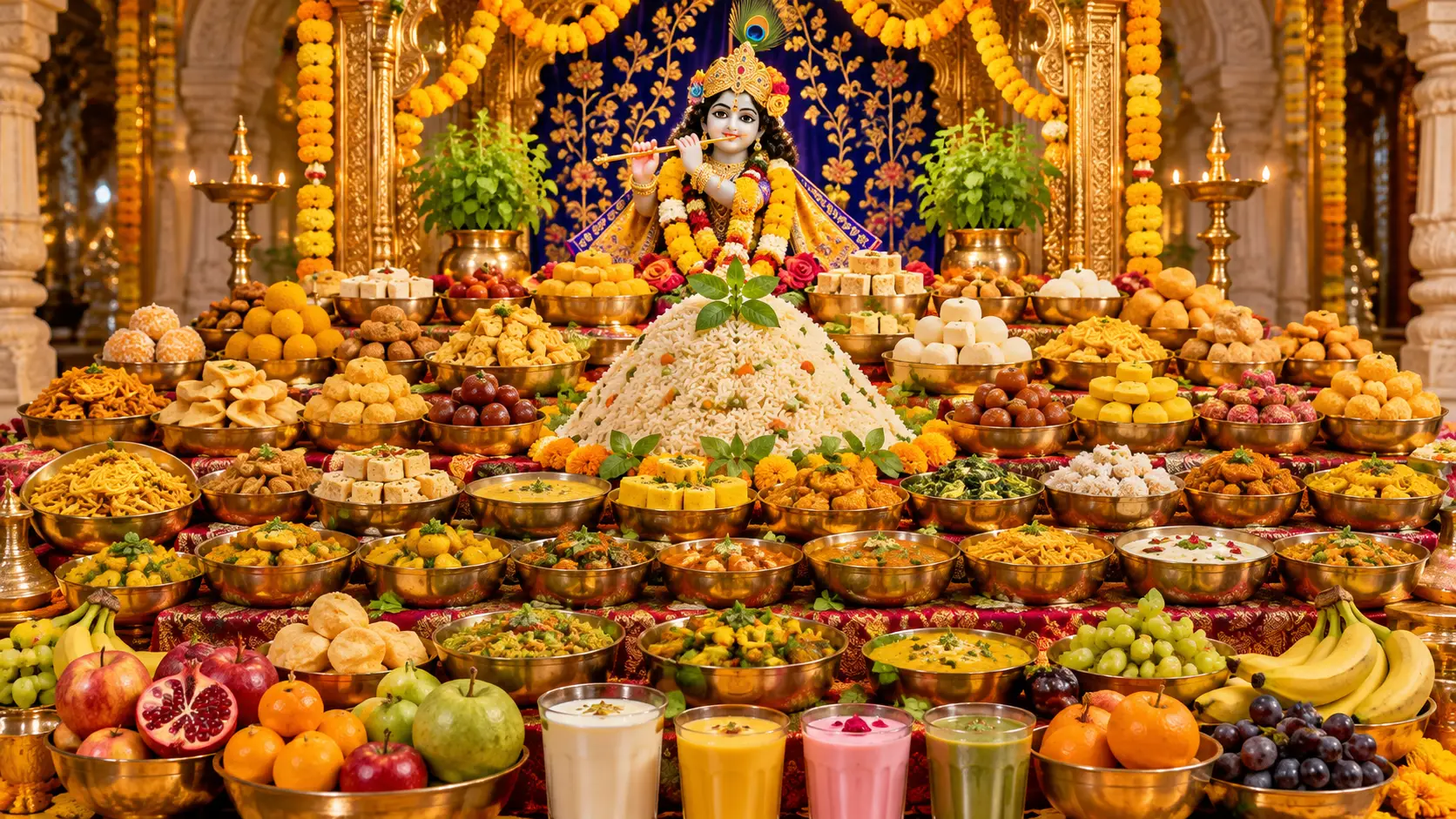
Chhappan Bhog means 56 offerings, and it is the grandest food offering made to Lord Krishna. On Govardhan Puja, which falls on Monday, 9 November in 2026, temples and homes lay out a mountain of dishes called Annakut (“a heap of grain”) before Krishna. Many families ask what exactly belongs in the Chhappan Bhog list. This guide explains why there are 56 dishes, the popular story behind the number, and a typical list of dishes by category.
Why 56 dishes? The popular story
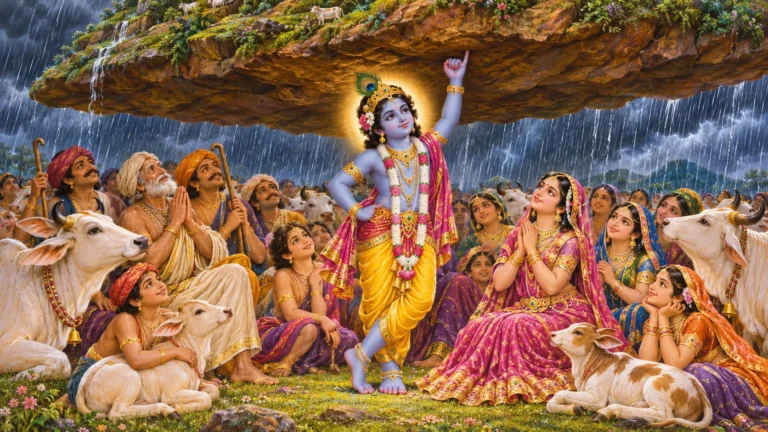
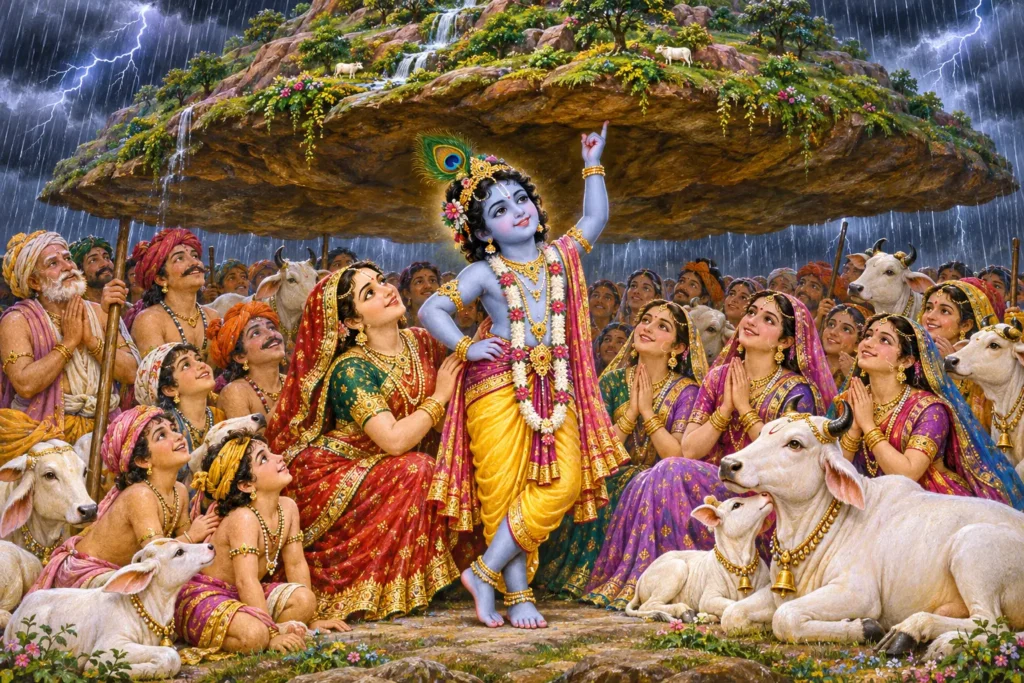
The Bhagavata Purana tells how young Krishna held up Govardhan Hill on his little finger for seven days to shelter the people of Vraja from Indra’s storm. A well-loved tradition adds that Mother Yashoda used to feed Krishna eight times a day. During the seven days he held the hill, he ate nothing. When the rain stopped, the villagers and Yashoda made up for all those meals at once: seven days with eight meals each makes 56 dishes. The Bhagavata Purana describes the Govardhan lifting and the first Annakut offering. The number 56 and the eight-meals-a-day detail come from devotional tradition. Read the full account in Govardhan Puja: Krishna lifting the mountain.
Is there one fixed Chhappan Bhog list?
No. The exact 56 dishes differ from temple to temple and region to region. Vrindavan, Mathura, Nathdwara and Puri each follow their own local lists, using the foods of their region. Families at home usually offer as many dishes as they can, with the number 56 as a goal rather than a strict rule. What matters in the tradition is that the food is pure, vegetarian, cooked without onion and garlic, and offered with devotion.
A typical Chhappan Bhog list by category
- Sweets: makhan-mishri (butter with rock sugar), kheer, rabri, basundi, malpua, jalebi, ghevar, motichoor and besan laddu, peda, rasgulla, gulab jamun, mohanbhog halwa, shrikhand, imarti
- Savouries: kachori, mathri, papad, pakora, dahi vada, namakpare
- Rice and breads: plain rice, khichdi, puri, roti, paratha, sweet rice
- Dal and vegetables: dal, kadhi, seasonal sabzi, suran (yam), baingan, saag, aloo dishes, bharta
- Drinks and dairy: milk, lassi, buttermilk (chaas), curd, thandai, sharbat
- Fruits and dry fruits: banana, apple, grapes, pomegranate, coconut, almonds, cashews, raisins, dates
- Accompaniments: chutneys, pickles, salad, tulsi leaves and paan
How Annakut and Chhappan Bhog are arranged
- Cook all the dishes fresh in a clean kitchen, with no onion or garlic.
- Place a mound of cooked rice in the centre to represent Govardhan Hill.
- Arrange the dishes in a circle or in tiers around it, with sweets nearest the deity.
- Place a tulsi leaf on the main dishes, since Krishna’s offerings are made with tulsi.
- Offer the bhog with a short prayer and aarti, then share the food as prasad with family, neighbours and the needy.
What if you cannot make 56 dishes?
Many families offer 11, 21 or 56 items, or a smaller thali with the foods Krishna is said to love most: butter, curd, milk and sweets. The Govardhan story is about gratitude for what nature gives, so a modest offering made sincerely is held to be as good as a grand one. See the Govardhan Puja page for the date and rituals, and the Diwali festival page for the five-day cycle around it.
Frequently asked questions
Why are 56 dishes offered to Krishna?
Krishna held Govardhan Hill for seven days without eating. Yashoda fed him eight times a day, so seven days times eight meals gives 56 dishes, according to popular tradition.
Is there a fixed Chhappan Bhog list?
No. The list differs by temple and region. Families offer as many dishes as they can, using vegetarian food without onion or garlic.
What is Annakut?
Annakut means a heap of grain and is the mountain of food offered to Krishna on Govardhan Puja, with a mound of rice standing for the hill.
Sources and further reading
Read our editorial policy on how scripture, Purana and folk tradition are labelled.