Damaru
डमरूThe damaru is the small hourglass-shaped drum of Shiva, held in Nataraja's upper right hand. Its sound stands for the rhythm of creation, and tradition holds that its fourteen beats gave rise to the Maheshvara Sutras, the basis of Sanskrit grammar.
What is the Damaru?
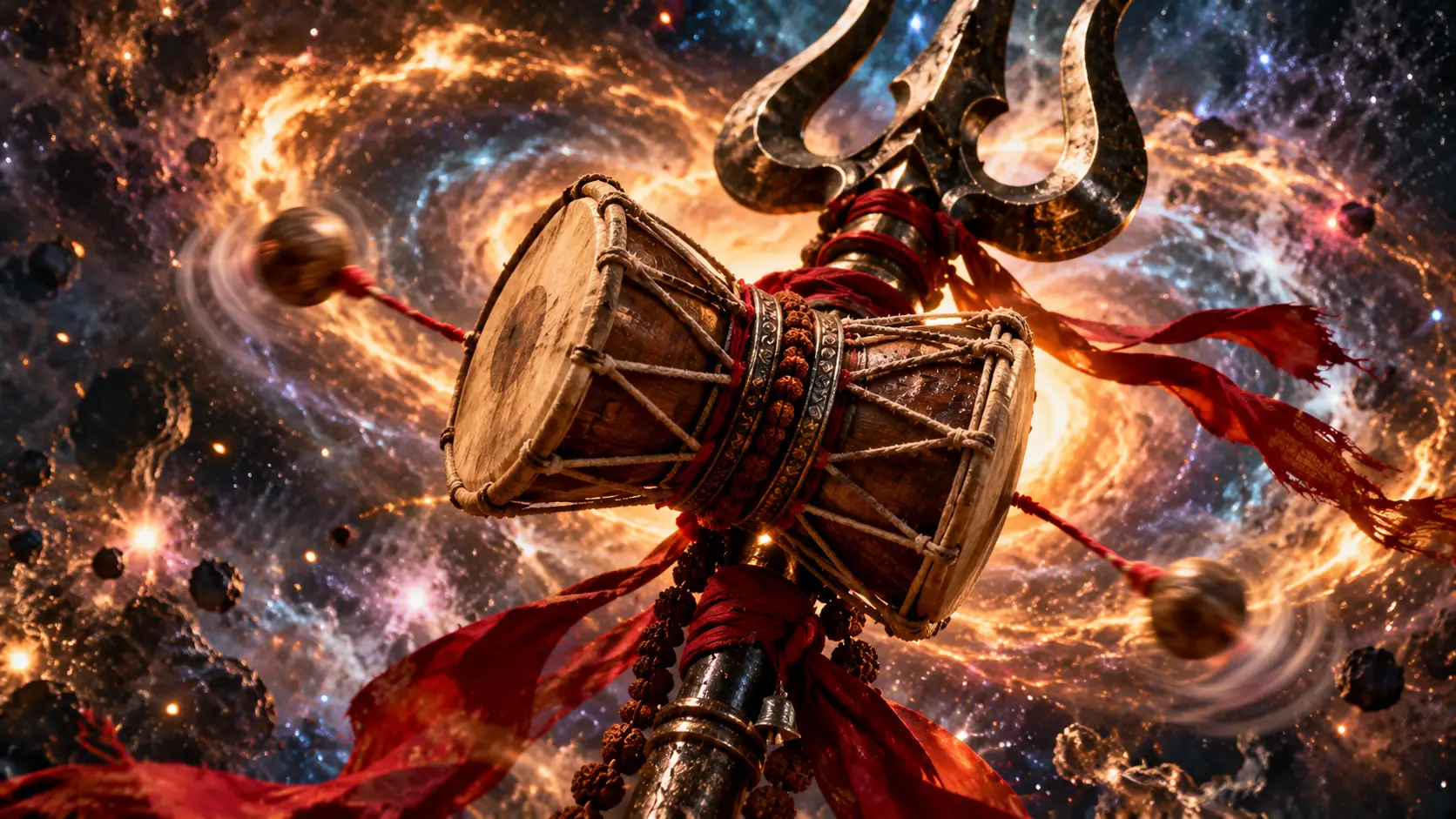
The damaru is a small two-headed drum shaped like an hourglass, with a cord and beads that strike the two skins when it is twisted rapidly in the hand. It is one of the objects most associated with Shiva, together with the trident, the serpent and the crescent moon.
The drum of Nataraja
In the great bronze images of Nataraja made in the Chola country of Tamil Nadu from the 10th century onward, Shiva dances within a ring of fire. In his upper right hand he holds the damaru, and in his upper left a flame. The two are read as a pair: the drum is the sound by which the universe begins, the fire the flame in which it ends, and between them the dance keeps the cosmos in motion. The hand that holds the drum is called the damaru-hasta.
The drum and the alphabet
A tradition found in the Nandikeshvara Kashika says that at the end of his cosmic dance Shiva sounded his drum fourteen times, and from those fourteen beats came the fourteen Maheshvara Sutras, the arrangement of the Sanskrit sounds on which the grammarian Panini built his grammar. The drum is thus the source not only of the world but of language itself.
In worship
The damaru is played in Shiva worship, by wandering ascetics and in the folk traditions of the Himalaya. It is often shown tied to the shaft of Shiva’s trident, the Trishula.
What does it symbolise?
The two drum heads joined at a narrow waist are read as the meeting of two worlds, the manifest and the unmanifest, or Shiva and Shakti. Its beat is nada, the primal sound from which creation unfolds, and its pairing with fire in Nataraja images…