Who was Alambush, and why is he remembered as one of the most mysterious rakshasas in the Mahabharata? Let’s uncover the story of this fearsome warrior who fought on the side of the Kauravas and met his end in one of the most dramatic duels of the epic war.
Who was Alambush in the Mahabharata?
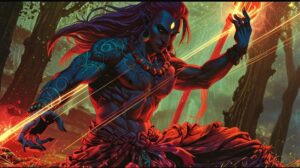
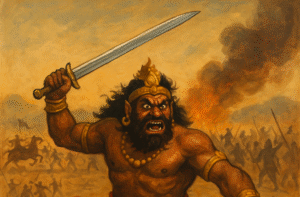
He was a rakshasa warrior who fought for the Kauravas during the great Mahabharata war. Known for his mastery over illusionary warfare (maya yuddha), he was a fearsome opponent who could multiply his forms, vanish into thin air, and summon terrifying visions on the battlefield.
But why did a rakshasa choose to fight for the Kauravas? The reason lies in revenge. Bhima had earlier killed his brother Vakasura, and Alambush joined the war to avenge that death.
What happened when Alambush fought Iravan?
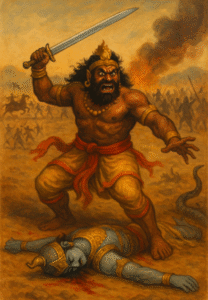
On the 8th day of the Mahabharata war, he faced Iravan, the brave son of Arjuna. Iravan was supported by the Nagas, but Alambush, using his illusions and strength, destroyed them mercilessly. After a fierce battle, he killed Iravan with his sword, marking one of his most significant victories in the war.
Did he fight other warriors too?
Yes, he fought several important duels during the Mahabharata. On the 7th day, he battled Satyaki, a powerful Yadava warrior. Despite invoking numerous illusions, he was defeated by Satyaki, who countered every one of his tricks.
The very next day, he confronted Abhimanyu, Arjuna’s valiant son. Again, he tried to overpower him through illusions, but Abhimanyu broke through every illusion and defeated him twice. These battles showed that while he was mighty, he was not invincible.
What role did he play on the 14th day of the war?
The 14th day was one of the bloodiest in the Mahabharata and also Alambush’s final day. He unleashed chaos on the battlefield, destroying over four hundred chariots that supported Bhima. He also killed many of Bhima’s soldiers, showing his unmatched destructive power.
However, Bhima eventually countered his illusions and fought back fiercely. The rakshasa did not retreat; instead, he faced Ghatotkacha, Bhima’s own son, who was also a master of illusionary warfare.
How did he die?
The battle between Alambush and Ghatotkacha was one of illusions against illusions. Both warriors created terrifying forms and magical attacks. He managed to match the combined attack of Ghatotkacha, Bhima, Yudhishthira, Nakula, Sahadeva, and the Upapandavas — a rare feat.

But even his power had limits. Eventually, Ghatotkacha’s superior strength and illusion overpowered him, and the rakshasa was killed on the 14th night of the Mahabharata war.
Were there other warriors named Alambush?
Interestingly, ancient texts mention two other warriors named Alambush who also fought for the Kauravas.
- One was a human king, who was eventually slain by Satyaki.
- The second was another rakshasa, the son of Jatasura (whom Bhima had also killed). He too fought for revenge and was killed by Ghatotkacha on the same night.
This often leads to confusion, but the most famous Alambush remains the rakshasa who killed Iravan and fought bravely until his death.
What made him unique among Kaurava warriors?
Unlike most warriors, he relied heavily on illusionary warfare. His ability to trick and terrify opponents made him one of the most unpredictable fighters in the Kurukshetra war. Despite fighting for the Kauravas, his courage and skill earned him respect even among his enemies.
In summary, he was not just another warrior he was a symbol of vengeance, illusion, and power. From killing Iravan to battling Abhimanyu and Ghatotkacha, his journey shows the complex web of revenge and fate that defined the Mahabharata.
Even though he fought for the wrong side, his bravery and command over illusion make him an unforgettable figure in the epic a reminder that in war, even the most fearsome warriors are bound by destiny.